
 |
 |
| 배홍용 HL만도 Harrison Bhae HL Mando |
이진환 HL만도 Jin-Hwan Lee HL Mando |
배홍용 HL만도 CTO, 수석부사장 / 한국자동차공학회(KSAE) 선임직 부회장, 지능형 섀시 및 제어부문회장
이진환 HL만도 SW Campus장, 전무
Editor's Note
모빌리티 혁신의 종착지는 과연 어디일까요?
하드웨어에서 소프트웨어 중심 구조(SDV)로 진화한 자동차 기술은 이제 도로라는 물리적 한계를 넘어 '로봇(Robotics)'이라는 새로운 생태계로 폭발적으로 확장되고 있습니다.
최근 한국자동차공학회(KSAE) '기술상'을 수상한 HL만도 배홍용 CTO와 이진환 SW Campus장의 오토저널 기고문(‘26년 5월호) 전문을 공개합니다. 수억 킬로미터의 혹독한 도로 위에서 검증된 자동차 엔지니어링 역량을 바탕으로, 소프트웨어 중심 로봇을 완성해 나가는 4단계 핵심 패러다임을 체계적인 학술 논문의 깊이로 만나 보시기 바랍니다.
Where is mobility innovation heading? Automotive technology, evolving from hardware-centric to software-defined vehicles (SDVs), is now rapidly expanding into robotics.
Through an article co-authored by HL Mando CTO Harrison Bhae, a recent KSAE Technology Award winner, and Jin-Hwan Lee, Head of SW Campus, published in the May 2026 issue of AUTO JOURNAL,
we introduce four key paradigms for building software-defined robots based on proven automotive technology.
[Summary] 4대 핵심 아키텍처 요약
[Summary] Four Core Architectures at a Glance
| 분류 | 당면 과제 | 자동차 SW 기반의 핵심 해법 | 기대 효과 및 기술 지표 |
| 1. 존 아키텍처 | 센서·액추에이터 전신 분산에 따른 배선 복잡도 및 통신 지연 |
중앙 고성능 컴퓨팅(HPC)과 신체 부위별 물리적 영역(Zone) 분산 제어 | 데이터 흐름 단순화, 초저지연 연산, 국소 결함 격리 (Fault Isolation) |
| 2. 표준화된 SW 플랫폼 | 다양한 하드웨어 규격과 소프트웨어 복잡성 급증 |
자동차 브레이크급 검증 체계 이식 및 공통 SW 자산 재사용 |
10만 건 이상 테스트 케이스 기반 품질 확보, 라인업 확장 및 OTA 지속 진화 |
| 3. 계층형 정밀 제어 |
환경 인지부터 모터 물리 구동까지의 조화로운 연계 |
What to do (상위) – How to move (중위) – Execute(하위) 3계층 제어 | 초고해상도 센서 위치 제어, 외란 관측기(DOB) 토크 보상, 열 인식 전력 최적화 |
| 4. 절대적 안전과 보안 |
인간과의 직접 공존에 따른 사고 위험 및 사이버 공격 급증 |
자동차 ASIL D급 신뢰성 (SIL 3)설계 및 DevSecOps 거버넌스 |
시간당 위험 고장률 10-7/hr 미만 달성, EU CRA 및 기계규정 선제 대응 |
| Category | Key Challenges | Core Solutions Based on Automotive Software | Expected Benefits and Technical Metrics |
| 1. Zonal Architecture | Wiring complexity and communication latency caused by sensors and actuators distributed throughout the body | Central high-performance computing (HPC) combined with distributed control across physical zones for individual body regions | Simplified data flows, ultra-low-latency computing, and local fault isolation |
| 2. Standardized SW Platform | Diverse hardware specifications and rapidly increasing software complexity | Adapting verification frameworks proven in automotive braking systems and reusing shared software assets | Quality assurance based on more than 100,000 test cases, product lineup expansion, and continuous evolution through OTA updates |
| 3. Hierarchical Precision Control | Coordinating the entire process from environmental perception to physical motor actuation | Three-layer control: What to do (high level) – How to move (mid level) – Execute (low level) | Precise position control using ultra-high-resolution sensors, torque compensation using disturbance observers (DOBs), and thermal-aware power optimization |
| 4. Absolute Safety and Security | Accident risks and rapidly increasing cyberattacks as robots coexist directly with humans | Design for automotive ASIL D-level reliability (SIL 3) and DevSecOps governance | A dangerous failure rate below 10⁻⁷ per hour and proactive compliance with the EU Cyber Resilience Act (CRA) and EU Machinery Regulation |
The Shift from Car to Robot: Evolution and Expansion of Mobility Software Technologies
The mobility industry is now entering a new stage of development as it shifts toward software-centric architectures. This transition has significant implications not only for the architecture of vehicle systems but also for the technological direction of related industries.
Convergence with robotics, in particular, exemplifies the automotive industry's potential to expand into new fields. The technological connections between these two sectors now warrant systematic examination.
This article examines how software technologies developed in the automotive sector can be extended to robotics and discusses the direction of robot software evolution, focusing on the key architectures and technologies that enable this expansion.
The Changing Mobility Paradigm and Expansion into Robotics
Interest in robots, particularly humanoid robots, is growing rapidly across industries. Against this backdrop, the automotive industry is moving beyond conventional means of transportation and expanding into new fields through convergence with robotics.
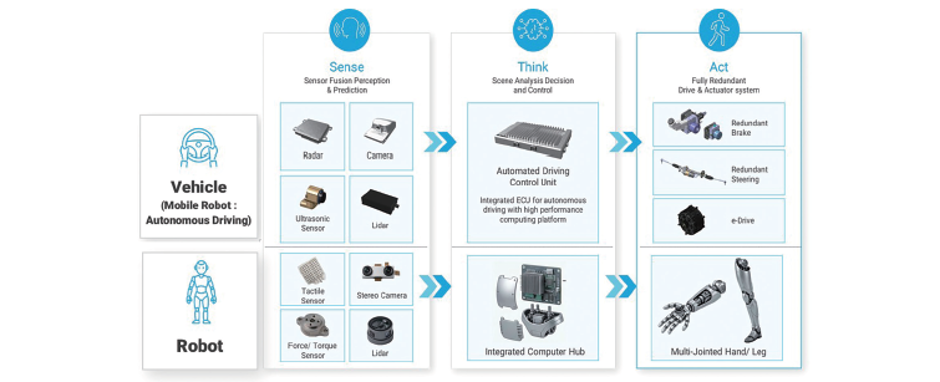
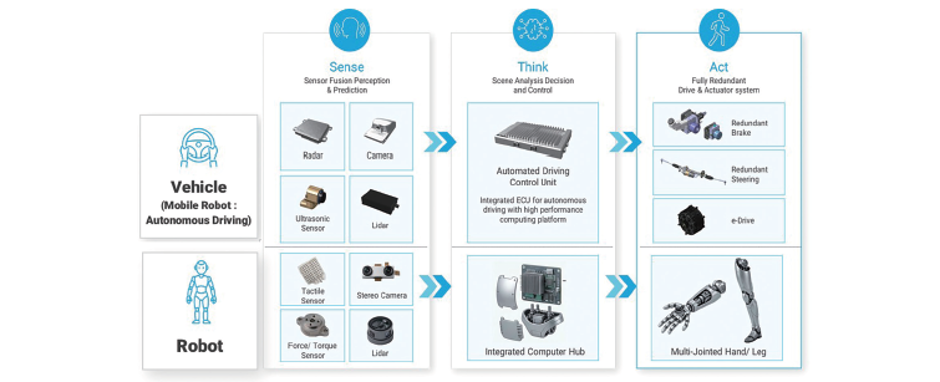
Although the automotive and robotics industries may appear distinct on the surface, they share substantial technological similarities. Sensor-based perception, decision-making algorithms, and control technologies developed for autonomous vehicles can be applied directly to robot development. This has been a major driver of automotive companies' entry into robotics. Their interest in the sector can be explained by three main factors.
The first is technological similarity. Autonomous vehicles and robots share a technological framework built around perception, decision-making, and physical control in complex environments. Fundamentally, they address the same problems.
The second is a shift in the industry's structure. As electrification and autonomous driving reshape the automotive industry, it is transitioning from a mechanically oriented industry to a software-centric one. This shift calls for new sources of growth, and robotics is attracting attention as a promising area for expansion.
The third is the potential to extend existing industrial capabilities. The automotive industry has already established mass-production systems and advanced quality management capabilities, which can also be applied effectively to robotics. Accordingly, numerous original equipment manufacturers (OEMs) and Tier 1 suppliers are pursuing strategic expansion into the robotics sector.
Another major development in the automotive industry is the transition to software-defined vehicles (SDVs). Whereas vehicle performance was once determined primarily by mechanical design, software has now become a central factor in defining both functionality and performance. An SDV has an architecture that enables continuous improvements in vehicle functionality and the user experience through software updates. Vehicle architectures are evolving accordingly, progressing from mechanically oriented structures to electronically controlled and domain-integrated architectures, and ultimately to software-centric architectures.
This transition goes beyond technological advancement to reshape the competitive landscape. Autonomous driving and motion control, in particular, are becoming key areas of competition in differentiating vehicle performance. The same software-centric approach applies to robot systems, where its importance is even greater because robots interact directly with humans.
The core elements common to vehicles and robots can be precision hardware, advanced software, and intelligent integrated control.
Focusing on software, this article discusses the key technologies required to extend automotive technologies to robotics and considers their future development.
Software Technologies for the Robotics Era
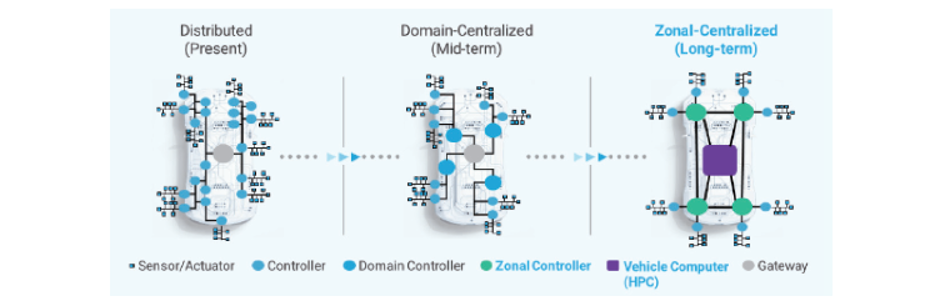
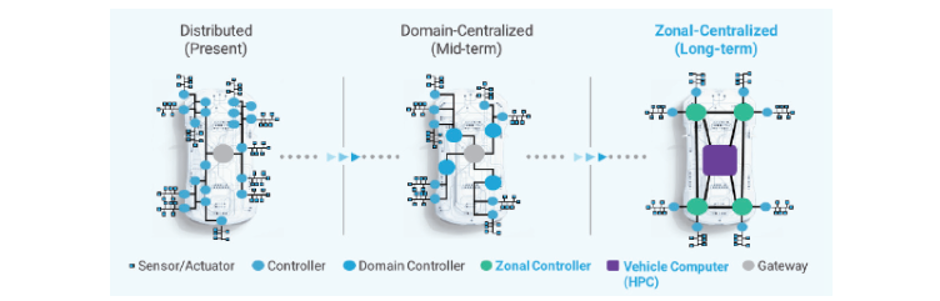
The structural transformation of the automotive industry is most evident in the transition to SDVs. The SDV represents an architecture in which software, rather than hardware, defines vehicle functionality and performance, enabling continued evolution through ongoing updates. This change entails a fundamental reconfiguration of vehicle architecture. Conventional architectures, in which functions are distributed across electronic control units (ECUs), are evolving through domain integration toward software-centric architectures based on centralized computing. This process improves the efficiency of system integration while substantially increasing functional scalability and development flexibility.
Robot systems require the same architectural transformation. For systems such as humanoid robots, which demand a high degree of integration and real-time processing, a software-centric architecture must underpin the approach from the earliest stages of design.
● Design Based on Zonal Architecture
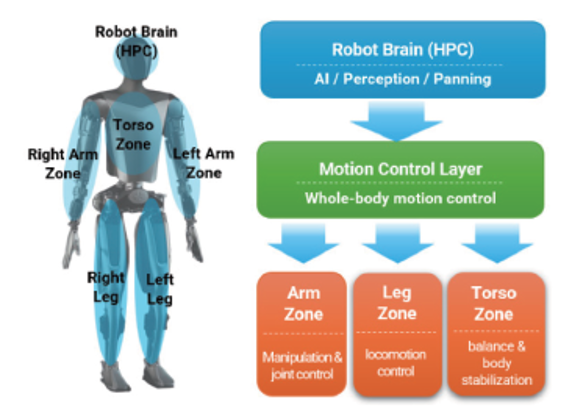
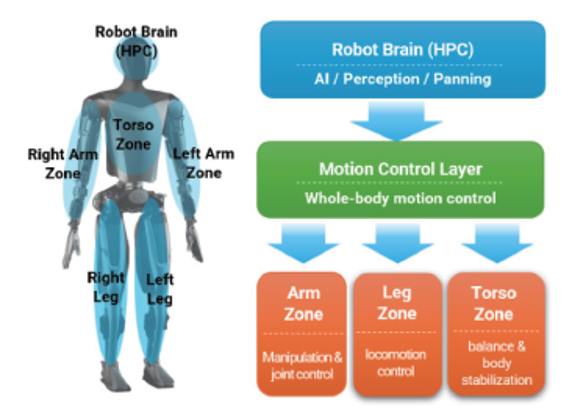
Zonal architecture organizes systems around physical regions rather than functions. This approach is well suited to robot systems, whose sensors and actuators are distributed throughout the body. By distributing control and computing functions across physical zones, it simplifies data flows and enables efficient wiring and communication structures. It also supports low-latency control and improves overall system efficiency by distributing computational loads across zones. Processing local sensor data directly within each zone reduces network traffic. If a fault occurs in a particular zone, it can be isolated within that zone, improving system robustness. Modular design also supports both scalability and ease of maintenance. Humanoid robots are expected to evolve toward architectures that combine a central control system based on high-performance computing (HPC) with zonal controllers for individual body regions. The automotive autonomous-driving function corresponds to the robot brain responsible for AI, perception, and planning, while vehicle motion control extends to the robot's whole-body motion control layer. Vehicle zonal controllers likewise correspond to controllers for individual robot body regions, ultimately connecting to the layer that drives the joint actuators.
● Standardized Software Platform
Humanoid robot systems are complex integrated systems that combine numerous hardware and software components. A standardized software platform is essential to their effective development.
A software platform manages system complexity by minimizing hardware dependencies and clearly defining interfaces between layers. It generally comprises a hardware abstraction layer, a communication and middleware layer, and a service and application layer. This layered structure enables functional separation and modularization.
The automotive industry has already established frameworks for large-scale software development and verification. For example, software embedded in an automotive braking system comprises approximately 10,000 functional software units, implements tens of thousands of requirements, and is repeatedly tested against more than 100,000 test cases. Before software is released for mass production, integration and verification are performed iteratively and incrementally, starting at the lowest level: the software unit. Defects are eliminated through rigorous processes aligned with international standards. In particular, automotive software reliability is supported by a configuration management framework that continuously incorporates more than 100 changes arising during development and generates and manages over 1,800 work products. Future humanoid robots will have a far broader range of functions and greater complexity than these braking systems, making software development and verification even more important.
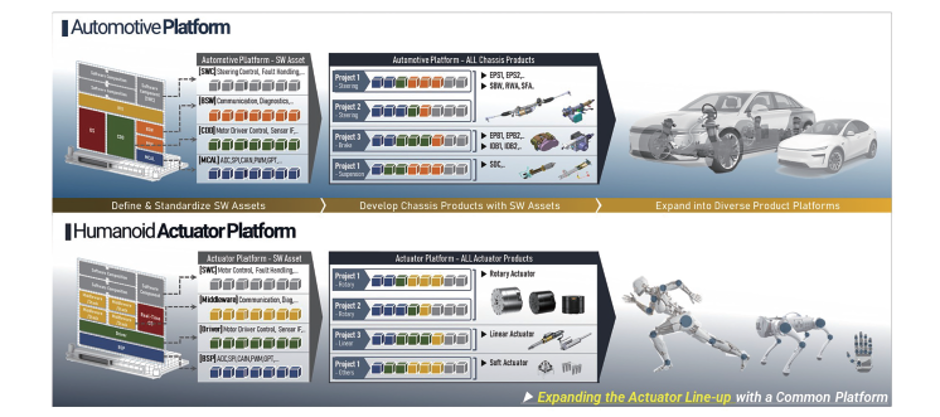
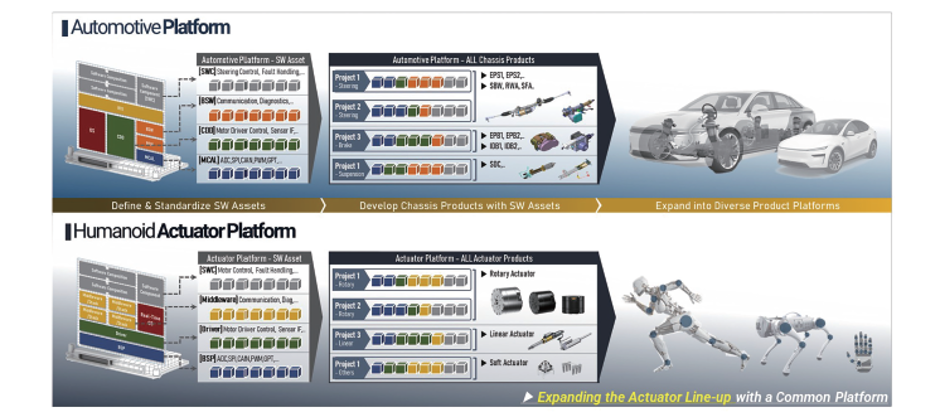
Standardizing the software platform is a key solution to this complexity. Standardization enables scalability. Just as shared software assets can be reused across chassis products with different functions to expand a product lineup efficiently, redefining, standardizing, and systematically managing software assets for robotics can accelerate the market launch of diverse robot product families. Incorporating over-the-air (OTA) technologies proven in mass-produced vehicles can also provide a foundation for safely improving and extending robot performance after deployment in the field.
● Precision Control
Humanoid robot control generally follows a hierarchical structure consisting of high-, mid-, and low-level control layers. At the high level, the robot brain perceives the surrounding environment and develops a strategy for what to do. Based on this strategy, mid-level control generates specific motions that determine how to move, enabling stable, coordinated movement and reliable physical interaction with the external environment. Low-level control receives these motion commands and executes them so that the joint actuators generate physical forces. Close coordination among these layers is essential to robot stability and natural movement.
At the low-level control layer in particular, actuator performance determines the performance of the overall system. Various motor technologies used in automotive chassis systems can also be applied to robot actuators. Robotics additionally requires compact designs, rapid response, and precision control. Meeting these requirements calls for precise position control using high-resolution sensors, torque compensation using disturbance observers, and compliance control for flexible interaction. Thermal-aware power optimization, which estimates temperature in real time and proactively limits torque before overheating occurs, is another important factor in improving system reliability and durability.
● Safety-Based Design
For humanoid robots designed to coexist with humans, ensuring safety is the foremost design principle. The automotive industry has seen cases in which inadequate safety measures have caused casualties and had far-reaching effects across the industry. Examples include Toyota's throttle control system, widely associated with large-scale recalls and accidents, and accidents caused by shortcomings in Tesla's automated driving systems. Similar incidents have been reported in robotics, including a fatal accident in which an industrial robot moved outside its work area and struck a worker in another area, and an accident in which inadequate safety design led to a worker being seriously injured by a robot during an inspection.
Unlike industrial robots operating in predictable environments, humanoid robots must interact directly with humans in environments that are difficult to predict. Safety functions are therefore essential to ensure that a robot's basic functions do not cause harm to people. These critical functions detect or assess conditions in which a robot could create a hazard and control the robot so that it operates in a safe state. This requires analyzing the system's basic functions to identify potential hazards, assessing the associated risks, and determining appropriate risk reduction measures, including safety functions. Safety requirements must then be defined on this basis, and the system must be developed in accordance with the processes, methodologies, and technical requirements specified in international standards. This sequence of safety engineering activities represents an engineering approach applicable to both automotive systems and robotics.
In terms of international safety standards, robotics, unlike the automotive sector, does not have a single integrated standard. Multiple standards must be applied together according to a system's characteristics and application. These include IEC 61508, a broadly applicable standard for the functional safety of electrical, electronic, and programmable electronic systems. ISO 13849 specifies characteristics, including performance levels, for safety-related parts of machinery control systems. Various application-specific standards also define safety requirements for industrial robots, service robots, and other robot categories, including ISO 10218 and ISO 13482.
These standards not only specify requirements but also define the levels of safety that a system's safety functions must achieve. Such levels are generally expressed in terms of safety integrity level (SIL) or performance level (PL). Systems must therefore be designed and verified to meet their required safety integrity levels. This approach provides a particularly important basis for robot systems.
As in the automotive industry, the approach set out in international standards reduces risks arising from robots through the following process. First, potential hazards posed by the robot are identified, and the level of risk associated with each hazard is assessed. Risk levels are generally determined by considering the severity of harm and its likelihood of occurrence. Risk reduction measures, including safety functions, are then defined to reduce the assessed risks to an acceptable level. Safety requirements are derived to incorporate these measures into the system design, and safety design is carried out in accordance with the applicable standards. This entire process must be carried out to the level required by those standards to demonstrate that the risks arising from the robot have been reduced to an acceptable level.
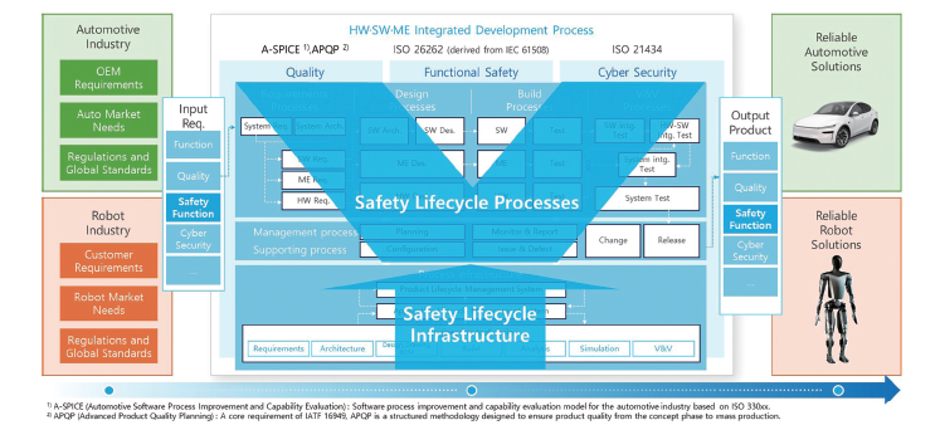
Automotive braking and steering systems, which are chassis components, are developed to meet Automotive Safety Integrity Level D (ASIL D) requirements. Although ASIL and SIL cannot be compared on a one-to-one basis, considering the hardware failure probabilities and development process rigor required for humanoid robots, ASIL D can be regarded as close to SIL 3. SIL 3 requires systems to be designed so that the probability of dangerous failure of a robot's safety functions remains extremely low, at less than 10⁻⁷ per hour. This calls for advanced safety design techniques and fault diagnostic capabilities. Because a single fault must not result in the loss of a safety function, system architectures must also be designed with fault-tolerant structures, such as redundancy or voting architectures, in mind. Meeting such high safety integrity requirements goes beyond implementing safety functions: safety must be a central consideration throughout engineering, including system architecture, hardware design, and software design.
The development processes and engineering infrastructure established for automotive systems requiring high safety integrity can also be applied to robot development, provided they are adapted to the characteristics of robot systems. They can thus serve as an important foundation for highly reliable robot systems.
● Security
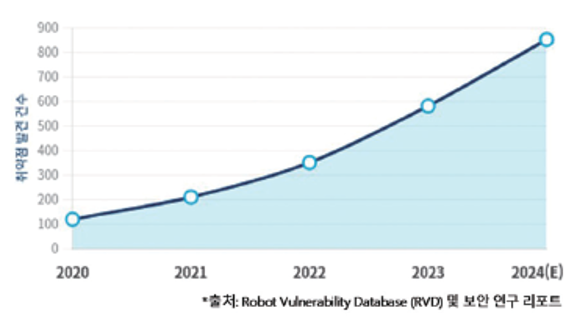
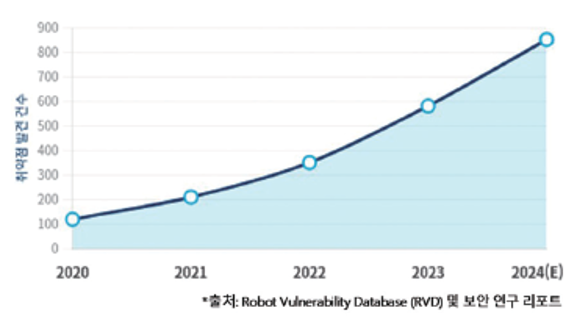
As robotic systems become more connected and more dependent on software, the importance of cybersecurity is growing rapidly. Robot hacking is already a real threat, and the number of robot-related security vulnerabilities discovered over the most recent five-year period has surged to more than three times the number found in the preceding five-year period. As the robotics industry expands, the attack surface is growing exponentially as well. With robot lifecycles spanning 10 to 20 years, security must be considered from the design stage.
Stringent legal frameworks are being introduced in global markets, with Europe taking the lead. Prominent examples include the EU Cyber Resilience Act (CRA) and the EU Machinery Regulation. Robot manufacturers have now entered an era of strict regulation in which they must demonstrate product security from the design stage; failure to do so will shut them out of the European market altogether.
The key standards providing underpinning these regulations are IEC 62443 and ISO/SAE 21434. The scope of application is expanding from IEC 62443, the established security standard for industrial automation and control systems (IACS), to ISO/SAE 21434, which has recently become essential in the automotive sector. This means that robot security is no longer optional but a baseline requirement, with these standards serving as a common technical language recognized across global markets.
The central themes of this extensive body of regulations and standards are the integration of safety and security, stronger supply chain security, security by design, and product lifecycle governance. In short, cybersecurity certification has become an essential prerequisite for market entry rather than an optional measure. Responding to these regulatory changes requires a V-cycle-based cybersecurity lifecycle and a DevSecOps framework proven in the automotive sector. In other words, adapting this process, in which security is automated and embedded from design through mass production and post-production support, to robot development can minimize trial and error while achieving quality quickly.
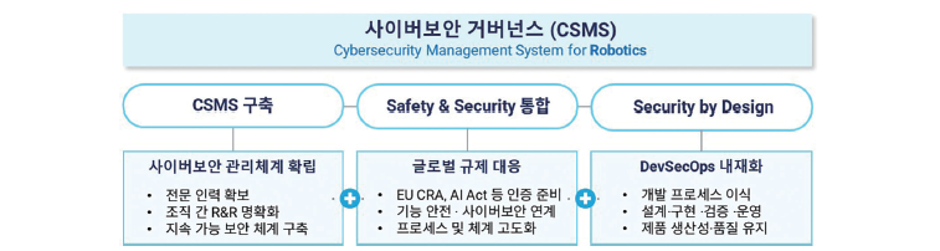
Robot cybersecurity requires three core pillars under robust Cyber Security Management System (CSMS) governance.
- CSMS Governance Implementation: Establish a cybersecurity management framework across the organization.
- Safety & Security Integration: Integrate safety and security to establish standards for meeting global regulatory requirements.
- Security by Design: Adhere to the principle of embedding security from the design stage to build structural robustness that proactively prevents vulnerabilities from the product planning stage onward.
Ultimately, security must be embedded as an inherent property of system design rather than treated as an individual function. This will become a key competitive factor in the future robotics industry.
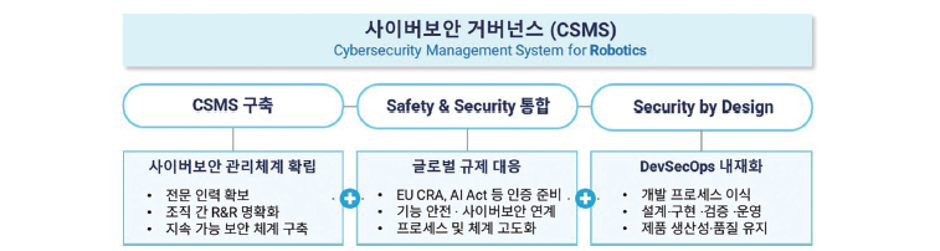
| Establishing a CSMS | Integrating Safety and Security | Security by Design |
| Establishing a Cyber Security Management System •Securing specialized personnel •Clarifying roles and responsibilities across organizational units •Establishing a sustainable security system |
Meeting Global Regulatory Requirements •Preparing for EU certifications, including those related to the CRA and AI Act •Linking functional safety and cybersecurity •Advancing processes and systems |
Embedding DevSecOps •Adapting the development process •Design, implementation, verification, and operation •Maintaining product productivity and quality |
The Future of Software-Centric Robots and Its Implications
The mobility industry is rapidly shifting from a hardware-centric to a software-centric model, and this transformation is extending beyond the automotive industry into robotics. Vehicles and robots should no longer be viewed as independent domains, but as parts of a technological continuum evolving on a shared foundation.
Zonal architecture, standardized software platforms, precision control, and safety and security technologies are key enablers of this transition. They provide the foundation for defining system architecture, delivering performance, and continuously expanding functionality.
The extensive experience in large-scale software development and the systems engineering capabilities accumulated in the automotive industry can be applied directly to robot development. They will play an important role in accelerating the maturation of the robotics industry.
Ultimately, the expansion from vehicles to robots is a natural evolution of existing technologies rather than a transition to an entirely new industry. From this perspective, the continuous advancement of software-centric technological capabilities will be a key source of competitiveness in the robotics industry of the future.
Harrison Bhae, Senior Executive Vice President (HL Mando) / Appointed Vice President and Chair of the Intelligent Chassis and Control Division, Korean Society of Automotive Engineers (KSAE)
자동차에서 로봇으로의 전환: 모빌리티 소프트웨어 기술의 진화와 확장
최근 모빌리티 산업은 소프트웨어 중심 구조로의 전환과 함께 새로운 발전 단계에 진입하고 있다. 이러한 변화는 차량 시스템의 구조 뿐만 아니라, 관련 산업 전반의 기술 방향에도 중요한 영향을 미치고 있다.
특히 로봇 기술과의 융합은 자동차 산업의 확장 가능성을 보여주는 대표적인 사례로, 두 분야 간의 기술적 연계성에 대한 체계적인 고찰이 필요한 시점이다.
이에 본 글에서는 자동차에서 축적된 소프트웨어 기술이 로봇으로 어떻게 확장될 수 있는지를 살펴보고, 이를 가능하게 하는 핵심 아키텍처와 기술 요소를 중심으로 로봇 소프트웨어의 진화 방향을 논의하고자 한다.
모빌리티 패러다임 전환과 로봇으로의 확장
최근 산업 전반에서 로봇, 특히 휴머노이드 로봇에 대한 관심이 빠르게 증가하고 있다. 이러한 흐름 속에서 자동차 산업 또한 전통적인 이동 수단을 넘어, 로봇과의 융합을 통해 새로운 분야로 확장되고 있다.
자동차와 로봇은 표면적으로는 서로 다른 산업처럼 보이지만, 기술적 관점에서는 높은 유사성을 갖는다. 자율주행 차량의 발전 과정에서 축적된 센서 기반 인지, 판단 알고리즘, 그리고 제어 기술은 로봇 개발에 직접적으로 활용될 수 있으며, 이는 자동차 기업들이 로봇 산업에 진입하는 주요 배경이 되고 있다. 자동차 기업들이 로봇 산업에 주목하는 이유는 크게 세 가지로 설명할 수 있다.
첫째, 기술적 유사성이다. 자율주행 차량과 로봇은 복잡한 환경에서의 인지, 판단, 그리고 물리적 제어라는 공통된 기술 구조를 기반으로 하며, 본질적으로 동일한 문제를 다루고 있다.
둘째, 산업 구조의 변화이다. 자동차 산업은 전동화와 자율주행을 중심으로 재편되면서, 기존의 기계 중심 산업에서 소프트웨어 중심 산업으로 전환되고 있다. 이러한 변화는 새로운 성장 동력을 요구하며, 로봇 산업은 그 유력한 확장 영역으로 주목받고 있다.
셋째, 산업 역량의 확장 가능성이다. 자동차 산업은 이미 대량 생산 체계와 높은 수준의 품질 관리 역량을 확보하고 있으며, 이러한 영향은 로봇 산업에도 효과적으로 적용될 수 있다. 이에 따라 다수의 OEM과 Tier-1 업체들이 로봇 분야로의 전략적 확장을 추진하고 있다.
한편, 자동차 산업의 중요한 변화는 소프트웨어 정의 차량(Software Defined Vehicle, SDV)으로의 전환이다. 과거 차량 성능이 주로 기계적 설계에 의해 결정되었다면, 현재는 소프트웨어가 기능과 성능을 정의하는 핵심 요소로 자리잡고 있다. SDV는 소프트웨어 업데이트를 통해 차량의 기능과 사용자 경험을 지속적으로 개선할 수 있는 구조를 의미하며, 이에 따라 차량 아키텍처 또한 기계 중심 구조에서 전자 제어 기반 구조, 그리고 도메인 통합 구조를 거쳐 소프트웨어 중심 구조로 진화하고 있다.
이러한 변화는 단순한 기술적 진보를 넘어 산업 경쟁 구도를 재편하고 있으며, 특히 자율주행 및 모션 제어 영역은 차량 성능을 차별화하는 핵심 경쟁 영역으로 발전하고 있다. 이러한 소프트웨어 중심 구조는 로봇 시스템에도 동일하게 적용되며, 오히려 인간과 직접 상호작용하는 로봇의 특성상 그 중요성은 더욱 강조된다.
자동차와 로봇을 관통하는 핵심 요소는 정밀한 하드웨어, 고도화된 소프트웨어, 지능형 통합제어로 정리할 수 있다.
본 고에서는 이 중 소프트웨어 관점을 중심으로, 자동차 기술이 로봇으로 확장되는 과정에서 요구되는 핵심 기술 요소와 향후 발전 방향을 논의하고자 한다.
로봇 시대를 위한 소프트웨어 기술
자동차 산업의 구조적 변화는 SDV로의 전환에서 가장 뚜렷하게 나타난다. 이는 차량의 기능과 성능이 하드웨어가 아닌 소프트웨어에 의해 정의되고, 지속적인 업데이트를 통해 진화하는 구조를 의미한다. 이러한 변화는 차량 아키텍처의 근본적인 재구성을 수반한다. 기존의 기능 분산형 ECU 구조는 도메인 통합 구조를 거쳐, 중앙 집중형 컴퓨팅 기반의 소프트웨어 중심 구조로 발전하고 있다. 이 과정에서 시스템 통합 효율성이 향상되고, 기능 확장성과 개발 유연성이 크게 증가하고 있다.
이와 같은 아키텍처 변화는 로봇 시스템에도 동일하게 요구된다. 특히 휴머노이드 로봇과 같이 고도의 통합성과 실시간 처리가 요구되는 시스템에서는, 초기 설계 단계부터 소프트웨어 중심 구조를 전제로 하는 접근이 필수적이다.
● 존 아키텍처(Zonal Architecture) 기반 설계
존 아키텍처는 기능 중심이 아닌 물리적 영역 기반으로 시스템을 구성하는 접근 방식이다. 이는 센서와 액추에이터가 전신에 분산되어 있는 로봇 시스템의 구조적 특성에 효과적으로 대응할 수 있는 아키텍처이다. 이 구조는 제어 및 연산 기능을 물리적 영역 단위로 분산 배치함으로써 데이터 흐름을 단순화하고, 배선 및 통신 구조를 효율적으로 구성할 수 있게 한다. 또한 저지연 제어가 가능하며, 연산 부하를 각 영역으로 분산시켜 전체 시스템 효율을 향상시킨다. 각 영역에서 로컬 센서 데이터를 직접 처리함으로써 네트워크 부하를 줄일 수 있으며, 특정 영역에 문제가 발생하더라도 해당 영역 내에서 결함을 격리할 수 있어 시스템 견고성이 향상된다. 더불어 모듈형 설계를 통해 시스템 확장성과 유지보수 용이성을 동시에 확보할 수 있다. 휴머노이드 로봇은 향후 고성능 컴퓨팅(High-Performance Computing, HPC)기반의 중앙 제어 시스템과 신체 부위별 존 제어기가 결합된 구조로 진화할 것으로 예상된다. 자동차의 자율주행 기능이 로봇에서는 AI, 인지, 계획을 수행하는 로봇 브레인에 대응되며, 차량 모션 제어는 로봇의 전신 모션 제어 계층으로 확장된다. 또한 차량의 존 제어기는 로봇의 신체 부위별 제어 구조로 대응되어, 최종적으로 관절 액추에이터를 구동하는 계층으로 연결된다.
● 표준화된 소프트웨어 플랫폼(Standardized SW Platform)
휴머노이드 로봇 시스템은 다수의 하드웨어와 소프트웨어 요소가 결합된 복잡한 통합 시스템으로, 이를 효과적으로 개발하기 위해서는 표준화된 소프트웨어 플랫폼이 필수적이다.
소프트웨어 플랫폼은 하드웨어 의존성을 최소화하고 계층 간 인터페이스를 명확히 정의함으로써 시스템의 복잡성을 관리한다. 일반적으로 하드웨어 추상화 계층, 통신 및 미들웨어 계층, 서비스 및 어플리케이션 계층으로 구성되며 이러한 계층 구조는 기능 분리와 모듈화를 가능하게 한다.
자동차 산업에서는 이미 대규모 소프트웨어 개발과 검증을 위한 체계가 확립되어 있다. 예를 들어 자동차 브레이크 시스템에 탑재되는 소프트웨어는 약 1만개의 소프트웨어 기능 유닛으로 구성되며, 수만 건 수준의 요구 사항을 구현하고, 10만 건 이상의 테스트 케이스를 반복 수행한다. 양산 소프트웨어 배포를 위해 최하위 레벨인 소프트웨어 유닛 단계부터 시작해 단계적 통합 및 검증을 반복하며, 글로벌 표준에 준하는 엄격한 프로세스를 통해 결함을 제거한다. 특히, 개발 과정에서 발생하는 100건 이상의 변경 사항을 지속적으로 반영하고, 1,800건 이상의 산출물을 생성, 관리하는 형상 관리 체계는 자동차 소프트웨어의 신뢰성을 뒷받침한다. 향후 휴머노이드 로봇은 이러한 브레이크 시스템보다 훨씬 방대한 기능과 높은 복잡도를 가질 것이며, 이에 따라 소프트웨어 개발 및 검증의 중요성은 더욱 커질 것이다.
이 복잡성을 해결할 핵심 해법은 SW 플랫폼의 표준화이다. 표준화는 곧 확장성을 의미하며, 섀시 제품과 같이 서로 다른 기능을 가진 제품들에서도 공통 SW자산을 재사용하여 효율적으로 라인업을 확장하는 것과 같이 로봇에서도 SW 자산을 재정의하고 표준화하여 관리한다면 다양한 로봇 제품군을 신속하게 시장에 선보일 수 있다. 또한 자동차의 대량 양산에서 검증된 OTA(Over-the-Air) 기술을 접목하면 로봇이 현장에 배포된 이후에도 안전하게 성능을 개선하고 확장할 수 있는 기반을 마련할 수 있다.
● 정밀 제어(Precision Control)
휴머노이드 로봇 제어는 일반적으로 상위, 중위, 하위 제어 계층으로 구성된 계층적 구조를 갖는다. 상위 제어는 로봇 브레인이 주변 환경을 인지하고 무엇을 할지(What to do) 전략을 세운다. 중위 제어는 이러한 상위 제어의 전략을 바탕으로 로봇이 안정적이고 조화롭게 움직일 수 있도록 어떻게 움직일지(How to move) 구체적인 모션을 생성한다. 이를 통해 외부 환경과 신뢰할 수 있는 물리적 상호작용이 가능해지도록 한다. 하위 제어에서는 앞선 모션 명령들을 받아 실제 관절 구동기가 물리적인 힘을 발생시키도록 명령을 실행(Execute)하는 기능을 수행한다. 이와 같은 계층 간 유기적 연계는 로봇의 안정성과 자연스러운 동작 구현을 위해 필수적이다.
특히 하위 제어 영역에서는 액추에이터 성능이 전체 시스템의 성능을 좌우한다. 자동차 섀시에 적용되는 다양한 모터 기술은 로봇 액추에이터에도 적용될 수 있으며, 로봇에서는 소형화와 더불어 빠른 응답성과 정밀 제어가 추가적으로 요구된다. 이를 위해 고해상도 센서를 활용한 정밀 위치 제어, 외란 관측기를 통한 토크 보상, 그리고 유연한 상호 작용을 위한 컴플라이언스 제어가 필요하다. 또한 온도를 실시간으로 추정하고 과열 전에 토크를 능동적으로 제한하는 열 인식 전력 최적화 기술은 시스템의 신뢰성과 내구성을 향상시키는 중요한 요소이다.
● 안전(Safety) 기반 설계
인간과 공존하도록 설계되는 휴머노이드 로봇을 생각할 때 안전성 확보는 가장 중요한 설계 원칙이다. 자동차 산업에서도 안전 확보가 미흡할 경우 인명 피해와 함께 산업 전반에 큰 영향을 미치는 사례들이 존재해 왔다. 예로 대규모 리콜과 사고 문제로 잘 알려진 도요타의 스로틀 제어시스템 사례나 완전하지 않은 테슬라 자동 주행 시스템으로 인해 발생한 사고 사례들이 있다. 로봇 분야에서도 유사한 사례로 산업용 로봇이 작업 구역을 벗어나 다른 작업 구역의 작업자와 충돌하여 사망 사고로 이어진 사례나 잘못된 안전 설계로 점검 중이던 작업자가 로봇에 의해 크게 다친 사고 사례들이 보고된 바 있다.
휴머노이드 로봇은 예측 가능한 환경에서 동작하는 산업용 로봇과 달리 예측하기 어려운 환경에서 인간과 직접 상호 작용해야 한다. 따라서 로봇이 수행하는 기본 기능이 인간에게 위해를 가하지 않도록 하기 위해서는 안전 기능(Safety Function)이 반드시 필요하다. 안전 기능은 로봇이 위험을 유발할 수 있는 조건을 감지하거나 판단하고, 로봇이 안전한 상태로 동작하도록 제어하는 매우 중요한 기능이다. 이를 위해서는 시스템의 기본 기능을 분석하여 잠재적인 위험원을 식별하고, 그 위험을 평가하여 적합한 안전 기능 등의 위험 저감 수단을 도출한다. 이를 기반으로 안전 요구사항을 정의하고, 글로벌 표준에서 요구되는 프로세스 및 방법론과 기술적 요구사항에 따라 시스템을 개발해야 한다. 이러한 일련의 안전 공학(Safety Engineering) 과정은 자동차와 로봇 분야에서 공통적으로 적용될 수 있는 엔지니어링 접근 방식이라고 볼 수 있다.
안전과 관련된 글로벌 표준 측면에서 로봇 안전 분야는 자동차와 달리 하나의 통합된 단일 표준이 존재하지 않으며, 시스템의 특성과 적용 분야에 따라 여러 표준을 함께 적용해야 한다. 먼저, 전기/전자/프로그램 가능 전자식 시스템의 기능 안전성 확보를 위해 범용적으로 적용 가능한 IEC 61508과 같은 표준이 있다. 그리고 기계 제어 시스템의 안전 관련 부품의 성능 수준을 포함한 특성을 명시하는 ISO 13849와 같은 표준이 있으며, 이 외에도 로봇의 적용 분야에 따라 산업용 로봇, 서비스 로봇 등 각각의 안전 요구사항을 정의하는 다양한 개별 표준들이 존재한다. (ISO 10218, ISO 13482 등)
이러한 표준들은 단순히 요구사항을 제공하는 것뿐만 아니라, 시스템의 안전 기능이 달성해야 하는 안전 수준을 정의하고 있다. 그리고 이 안전 수준은 일반적으로 SIL(Safety Integrity Level)이나 PL(Performance Level)과 같은 개념을 통해 표현된다. 따라서 시스템에 요구되는 안전 무결성 수준을 만족할 수 있도록 설계 및 검증되어야 하며, 이러한 접근 방식은 로봇 시스템에서 매우 중요한 기준이 된다.
자동차 산업과 마찬가지로 글로벌 표준에서 제시하는 접근 방식에 따라 로봇으로 인해 발생할 수 있는 위험(Risk)을 줄여 나가는 방식은 다음과 같다. 가장 먼저 로봇으로 인해 발생할 수 있는 위험 요소(Hazard)를 식별하고, 각 위험 요소에 대해 위험 수준을 평가한다. 이 과정에서 일반적으로 위험 수준의 피해 심각도와 발생 가능성을 고려하여 위험 수준을 결정하게 된다. 이렇게 평가된 위험을 허용 가능한 수준으로 낮추기 위해 안전 기능 등의 위험 저감 수단들을 정의하게 된다. 정의된 위험 저감 수단들을 시스템 설계에 반영하기 위해 안전 요구사항들을 도출하고 관련 표준의 요건에 따라 안전 설계를 수행하게 된다. 이러한 일련의 과정을 관련 표준의 요건들을 달성하는 수준으로 이행하여 로봇으로 인한 위험을 허용 가능한 수준까지 낮추었음을 입증해야 한다.
자동차 섀시 부품인 제동 및 조향 시스템은 ASIL D 수준의 요구사항을 만족하도록 개발되고 있다. ASIL 과 SIL을 1:1로 비교할 수는 없지만 휴머노이드 로봇에서 요구되는 하드웨어 고장 확률이나 개발 프로세스의 엄격성을 고려해 보면 이는 SIL 3와 근접한 수준으로 판단된다. SIL 3는 로봇 안전 기능의 위험 고장 확률이 극히 낮은 수준(10-7/hr 미만 수준)이 되도록 시스템을 설계해야 하며, 이를 위해 높은 수준의 안전 설계 기법과 고장 진단 기능이 요구된다. 또한 단일 고장으로 인해 안전 기능이 상실되지 않도록 해야 하기 때문에 시스템 아키텍처 측면에서도 이중화 구조나 Voting 구조와 같은 내결함(Fault Tolerance)구조를 고려하여 시스템을 설계하게 된다. 이처럼 높은 안전 무결성 수준을 만족하기 위해서는 단순히 안전 기능을 구현하는 수준을 넘어, 시스템 아키텍처, 하드웨어 설계, 소프트웨어 설계까지 전체 엔지니어링이 안전을 중점적으로 다루어야 한다.
높은 안전 무결성을 요구하는 자동차 시스템 개발 과정에서 구축된 개발 프로세스와 엔지니어링 인프라는 로봇 시스템의 특성을 고려한 보완을 전제로 로봇 시스템 개발에도 적용될 수 있으며, 이는 고신뢰성 로봇 시스템 구현을 위한 중요한 기반이 될 수 있다.

● 보안(Security)
로봇 시스템의 연결성과 소프트웨어 의존성이 증가함에 따라 사이버 보안의 중요성 또한 급격히 증가하고 있다. 로봇 해킹은 이미 현실의 위협이 되고 있고, 최근 5개년 동안 발견된 로봇 관련 보안 취약점은 지난 5년전과 비교해 무려 3배 이상 급증했다. 로봇 산업이 팽창하는 속도만큼 공격자가 노릴 수 있는 접점 또한 기하급수적으로 늘어나고 있다고 볼 수 있다. 특히 로봇의 수명주기는 10년에서 20년에 달하기 때문에 설계 단계부터의 보안 고려가 필수적이다.
최근 글로벌 시장에서는 유럽을 필두로 강력한 법적 장치들이 마련되고 있는데 대표적으로 EU CRA(사이버 복원력 법안)와 EU Machinery Regulation(기계 규정)이 있다. 이제 로봇 제조사는 제품의 설계 단계부터 보안성을 입증해야 하며, 이를 충족하지 못하면 유럽 시장 진입 자체가 불가능해지는 강력한 규제의 시대가 열린 것이다.
이러한 법규를 기술적으로 뒷받침하는 핵심 표준은 IEC 62443과 ISO/SAE 21434이다. 기존 산업 제어 시스템의 보안 표준인 IEC 62443, 최근 자동차 분야에서 필수적인 ISO/SAE 21434까지 적용 범위가 확대되고 있다. 이는 로봇 보안이 더 이상 권고가 아닌 글로벌 시장에서 통용되는 공통의 언어이자 기술적 규격이 되었음을 의미한다.
이러한 방대한 법규와 표준의 핵심 내용을 정리하면 안전과 보안의 통합, 공급망 보안 강화, 설계 단계부터 보안성 확보(Secure by Design), 제품 수명주기 관리(Lifecycle Governance)이다. 즉, 사이버 보안 인증은 시장 진입을 위한 선택 사항이 아니라 반드시 넘어야 할 필수 전제 조건이 되었다. 이러한 규제 변화에 대한 대응을 위해서는 자동차 분야에서 검증된 V-사이클 기반의 사이버보안 라이프사이클과 DevSecOps 체계가 요구된다. 다시 말해 설계부터 양산, 그리고 사후 관리까지 보안이 자동화되고 내재화된 이 프로세스를 로봇 개발 공정에 이식하면 시행 착오를 최소화하면서도 빠르게 품질을 확보할 수 있다.
로봇 사이버보안을 위해서는 견고한 CSMS(사이버보안 관리 체계) 거버넌스 아래 세 가지 핵심 축을 구축해야 한다. 첫째, 전사적 CSMS 구축을 통해 사이버보안 관리체계를 확립해야 한다. 둘째, 안전과 보안을 통합하여 글로벌 규제 대응 표준을 구축해야 한다. 셋째, 설계 단계부터 보안을 내재화하는 원칙을 고수하여 제품 기획 단계부터 취약점을 사전에 차단하는 구조적 강인함을 갖추어야 한다. 결국 보안은 개별 기능이 아니라 시스템 설계의 기본 속성으로 내재화되어야 하며, 이는 향후 로봇 산업의 핵심 경쟁 요소로 작용할 것이다.
소프트웨어 중심 로봇의 미래와 시사점
모빌리티 산업은 하드웨어 중심에서 소프트웨어 중심으로 빠르게 전환되고 있으며, 이러한 변화는 자동차 산업을 넘어 로봇 산업으로 확장되고 있다. 자동차와 로봇은 더 이상 독립적인 영역이 아니라 공통의 기술 구조를 기반으로 진화하는 하나의 연속된 시스템으로 이해할 필요가 있다.
특히 존 아키텍처, 표준화된 소프트웨어 플랫폼, 정밀 제어, 그리고 안전 및 보안 기술은 이러한 전환을 가능하게 하는 핵심 요소이다. 이들 기술은 시스템의 구조를 정의하고, 성능을 구현하며, 지속적인 기능 확장을 가능하게 하는 기반으로 작용한다.
자동차 산업에서 축적된 대규모 소프트웨어 개발 경험과 시스템 엔지니어링 역량은 로봇 시스템 개발에 직접적으로 적용될 수 있으며, 이는 로봇 산업의 성숙도를 빠르게 높이는 중요한 요소가 될 것이다.
결국 자동차에서 로봇으로의 확장은 새로운 산업으로의 전환이 아니라, 기존 기술의 자연스러운 진화 과정이다. 이러한 관점에서 소프트웨어 중심의 기술 역량을 지속적으로 고도화하는 것이 미래 로봇 산업에서의 핵심 경쟁력이 될 것이다.
배홍용 HL만도 수석부사장 / 한국자동차공학회 선임직 부회장, 지능형 섀시 및 제어부문회장


