
30 Years of Chassis Heritage and an Engineering Philosophy That Stands the Test of Time
Editor’s Note
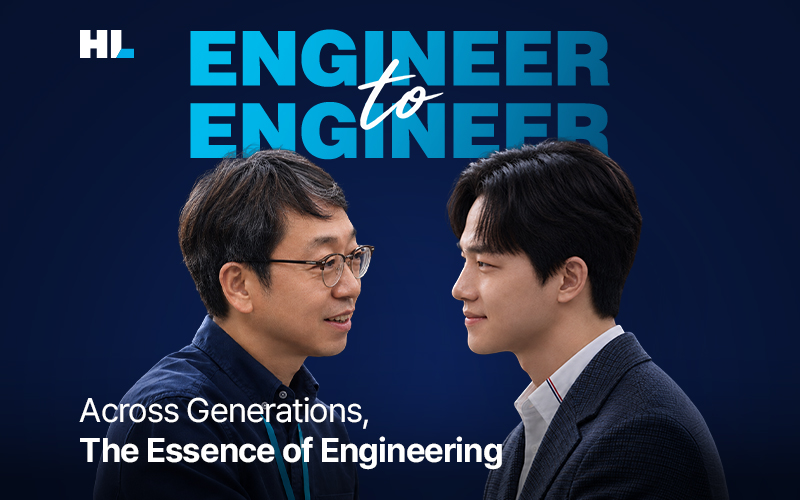
As the mobility industry rapidly shifts from hardware to software, Harrison Bhae, CTO and recipient of the 2026 Technology Award from The Korean Society of Automotive Engineers (KSAE), sat down with a young engineer in advanced technology research. Their conversation ranges from the intense early days of in-house EPS development to AI and data-driven control, by-wire system architecture, and new ways of working in an era of convergence. This candid cross-generational dialogue explores the fundamentals of automotive engineering.
하드웨어에서 소프트웨어 중심으로 빠르게 재편되는 모빌리티 산업. 이 거대한 전환기 한가운데서, 2026년 한국자동차공학회(KSAE) ‘기술상’을 수상한 배홍용 CTO와 선행기술을 연구하는 2030 엔지니어가 마주 앉았습니다. 과거 EPS 독자 개발의 치열했던 현장부터 AI 데이터 제어, By-Wire 시스템 아키텍처, 융합의 시대에 일하는 방식까지. 세대를 뛰어넘어 자동차 기술의 본질을 파고든 두 엔지니어의 깊고 진솔한 대화를 전해드립니다.
Meet the Participants
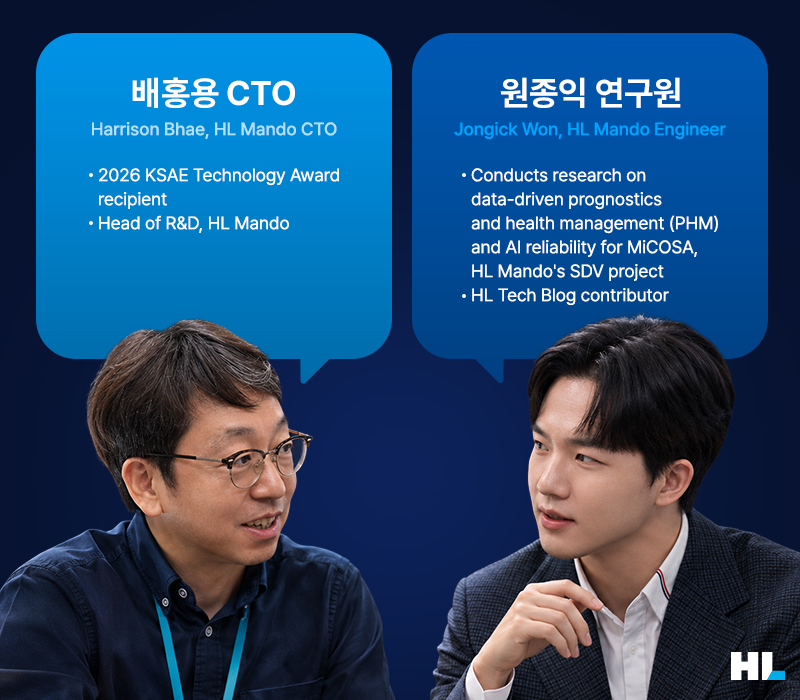
- Harrison Bhae, CTO (2026 KSAE Technology Award recipient / Head of R&D, HL Mando)
- Jongick Won, Research Engineer (M²MCx Team / Conducts research on data-driven prognostics and health management (PHM) and AI reliability for MiCOSA, HL Mando's SDV project; HL Tech Blog contributor)
대담자 소개
- 배홍용 CTO (2026 KSAE 기술상 수상 / HL만도 연구개발 총괄)
- 원종익 연구원 (M²MCx팀 / 만도 SDV 프로젝트 MiCOSA에서 데이터 기반 고장 예측(PHM) 및 인공지능 신뢰성 확보 연구 수행, HL Tech Blog 필진)
PART 1. Heritage: The Tenacity to Get to the Root of a Problem
PART 1. 헤리티지 : 현상의 본질을 파고드는 집요함
Jongick Won: First, congratulations on receiving the 2026 KSAE Technology Award. All of us junior engineers were delighted to hear the news. Over the past 30 years, mobility has shifted rapidly from hardware-centered systems toward software-defined vehicles. This award is especially meaningful because it shows that our company is leading that major transition.
원종익 연구원 (이하 원종익) : 부사장님, 2026 KSAE 기술상 수상을 진심으로 축하드립니다! 저희 후배들도 소식을 듣고 정말 기뻤습니다. 30년 전 하드웨어 중심이었던 모빌리티 트렌드가 오늘날 소프트웨어 중심으로 숨가쁘게 변하고 있는데요, 이번 수상은 그 거대한 트렌드를 당사가 굳건히 이끌고 있다는 방증인 것 같아 감회가 새롭습니다.
Harrison Bhae
: Thank you (laughs). I see this Technology Award not as a personal achievement, but as an award I accepted on behalf of the company as CTO responsible for R&D and technology. We have successfully brought by-wire systems such as SbW (Steer-by-Wire) and EMB, as well as leading SDV software solutions such as MiCOSA, into mass production. I take this award as recognition of the dedication of our entire R&D organization, which built this strong foundation together.
배홍용 CTO (이하 배홍용) : 축하해 줘서 고맙습니다(웃음). 이번 기술상 수상은 사실 제 개인의 업적이라기보다, 당사의 연구개발과 기술을 총괄하는 CTO로서 회사를 대표해 받은 상이라고 생각합니다. 우리가 SbW나 EMB 같은 By-Wire 시스템, 그리고 MiCOSA 같은 SDV 선도 SW 솔루션을 성공적으로 양산해 내고 있잖아요? 이 튼튼한 토대를 함께 일궈낸 우리 연구개발 인력 전체의 땀방울에 대한 격려로 받아들이고 있습니다.
Jongick Won: You mentioned that foundation. Would it be fair to say that the in-house development of EPS (Electric Power Steering) was a pivotal step in establishing our chassis technology? With no precedent to draw on, advanced development and mass production must have been far from straightforward. When you were working to overcome nonlinear physical characteristics such as steering hysteresis and gear friction, how did you use extensive vehicle testing beyond simulation to find the answers?
원종익 : 방금 ‘토대’라는 말씀을 해주셨는데, 사실 그 섀시 기술의 토대를 다진 핵심 사건이 과거 ‘EPS(전자식 조향장치) 독자 개발’ 아닐까요? 레퍼런스조차 없던 시절, 선행 개발과 양산을 추진하시는 과정이 결코 순탄치 않았을 텐데요 특히 조향계의 히스테리시스나 기어 마찰 같은 비선형적인 물리 특성을 극복하실 때, 시뮬레이션 밖에서 수많은 필드 테스트를 통해 해답을 얻어내셨던 부사장님만의 노하우가 궁금합니다.
Harrison Bhae: When we were developing EPS in-house, the R&D environment was not as sophisticated as it is today. We learned through a great deal of trial and error. In steering, response measured in data is important, but so is the subjective steering feel that drivers experience through their fingertips. I focused on quantifying that subjective response through engineering and accumulated experience.
There is one principle we must never forget: "Every phenomenon observed in testing has an underlying physical theory and technical basis." When unexpected noise or anomalous behavior appears, we cannot simply mask the symptom through calibration and move on.
배홍용 : EPS 독자 개발 당시엔 지금처럼 연구개발 환경이 충분하지 않았어요. 몸으로 부딪히며 시행착오를 참 많이 겪었죠. 특히 조향은 데이터상의 제어 응답성도 중요하지만, 운전자가 손끝으로 직접 느끼는 정성적인 ‘조향감’이 핵심입니다. 저는 이 감성적인 지표를 엔지니어링과 경험치를 통해 정량화하는 데 온 힘을 쏟았습니다.
여기서 절대 잊지 말아야 할 원칙이 하나 있어요. “실제 테스트에서 나타나는 모든 현상에는 반드시 물리적 이론과 기술적 근거가 있다”는 겁니다. 예상치 못한 노이즈나 이상 거동이 발생했을 때, 단순히 캘리브레이션 튜닝으로 현상만 살짝 덮고 넘어가면 절대 안 된다는 의미죠.
Jongick Won: I see. We cannot simply mask the symptoms and move on.
원종익 : 아, 현상만 덮고 넘어가면 안 된다…
Harrison Bhae: Exactly. We must seek out the theories and papers that explain why a phenomenon occurs, analyze the system's physical characteristics, and internalize the underlying principle through further testing. In mass production, of course, we must consider functional safety, reliability, quality, cost, and productivity. That means consistent performance and robustness may sometimes be more practical than theoretical perfection. The most important lesson I learned from developing EPS in-house is that an engineer grows by persistently pursuing the root cause of every phenomenon.
배홍용 : 맞아요. 왜 그런 현상이 발생했는지 이론과 논문을 찾고, 시스템의 물리적 특성을 분석하고, 다시 시험을 통해 그 원리를 온전히 내 것으로 체득해야 합니다. 물론 양산의 세계로 넘어오면 기능 안전, 신뢰성, 품질, 원가, 생산성을 모두 따져야 하니 완벽한 이론보다는 ‘일관된 성능과 강건성’이 더 나은 선택이 될 때도 있습니다. 결국 EPS 독자 개발을 통해 제가 배운 단 하나의 교훈은, 현상의 본질을 끝까지 파고드는 집요함만이 엔지니어를 성장시킨다는 겁니다.
PART 2. Technology Evolution: Physics-Based Models, AI, and Architecture
PART 2. 기술의 진화 : 물리 모델과 AI, 그리고 아키텍처
Jongick Won: Your emphasis on getting to the root of a problem closely relates to a challenge I am working on today. I am researching physics-augmented AI, which incorporates physical information during training to improve the reliability of AI models.
원종익 : 본질을 파고들어야 한다는 말씀이 지금의 제 고민과도 맞닿아 있는 것 같습니다. 저는 최근 AI 모델의 신뢰성을 높이기 위해 물리적 정보를 함께 학습시키는 Physics-augmented AI를 연구 중이거든요.
Data Predicts Steering Lifespan: The Completion of Deep Learning-Based EPS Prognostics Technology
데이터가 스티어링의 수명을 예견하다, 딥러닝 기반 EPS 고장 예지 기술의 완성
데이터가 스티어링의 수명을 예견하다, 딥러닝 기반 EPS 고장 예지 기술의 완성
Author's Note안녕하세요, HL만도 글로벌 R&D 센터에서 지능형 제어 및 고장 예지 기술을 연구하고 있는 원종익 연구원입니다.현대 자동차의 필수 요소로 자리 잡은 전동식 조향 장치(EPS, Electric Power S
www.hlworld.com
You have led chassis design and validation based on physical theory and models for many years. How do you think today's AI and data-driven technologies should converge with conventional physics-based modeling and evolve in the years ahead?
부사장님께서는 오랜 기간 물리 이론과 모델에 기반한 섀시 설계와 검증을 이끌어 오셨는데요. 최근 각광받는 AI나 데이터 기반 기술이 기존의 물리 모델 기술과 앞으로 어떤 방향으로 융합하며 발전해야 한다고 보시는지 궁금합니다.
Harrison Bhae: To answer directly, I do not see conventional physics-based technology and AI or data-driven technology as substitutes for one another. They should complement each other by building on their respective strengths.
Vehicles and chassis are physical systems governed by the laws of physics. Yet changes in actual driving conditions and complexities such as component wear are difficult to represent with complete accuracy using physics models alone. That is where AI can create new value, including prognostics and health management (PHM), state estimation, and control performance optimization, as in your research.
배홍용 : 결론부터 말씀드리면, 저는 물리 법칙을 바탕으로 하는 기존 기술과 AI/데이터 기반 기술을 서로 밀어내는 대체 관계로 보지 않습니다. 각각의 강점을 바탕으로 상호 보완하고 발전해 나가야 하는 관계죠.
차량 및 섀시 시스템은 기본적으로 물리 법칙에 따라 동작하는 물리 시스템입니다. 하지만 실제 주행 환경의 변화나 부품 마모 같은 복잡성은 물리 모델만으로 100% 정확히 표현하기 어렵거든요. 바로 그 틈에서 AI가 새로운 가치를 제공할 수 있다고 생각합니다. 원 연구원님이 연구하는 고장 조기 예측(PHM)이나 상태 추정, 제어 성능 최적화처럼 말이죠.
Jongick Won: So the key is for AI to complement the limitations of physics models. When these new AI technologies move beyond research and into mass production, what criterion matters most to you?
원종익 : 물리 모델의 한계를 AI가 채워주는 상호 보완적인 시너지가 중요하다는 말씀이군요. 그렇다면 연구 단계를 넘어, 이러한 새로운 AI 기술을 실제 양산에 적용하실 때 부사장님께서 가장 중요하게 보시는 ‘기준’은 무엇인가요?
Harrison Bhae: The most important step is to ask ourselves two questions: "What problem requires us to use AI?" and "What tangible value will it deliver to the customer?"
The required standards for reliability and validation should vary according to where AI is applied and how significantly it affects system safety. For a safety-critical system, robustness under unforeseen conditions is paramount.Ultimately, production readiness depends on convergence engineering: a solid understanding of physics models, intelligent use of AI and data, and the ability to translate them into real product value.
배홍용 : 결국 가장 중요한 기준은 '우리가 어떤 문제를 해결하기 위해 AI를 꼭 써야 하는가', 그리고 '이것이 고객에게 어떤 실질적인 가치를 주는가'를 스스로에게 먼저 묻는 것입니다.
물론 AI가 어디에 적용되느냐, 또 시스템 안전에 얼마나 큰 영향을 미치느냐에 따라 요구되는 신뢰성이나 검증의 잣대도 당연히 달라져야겠죠. 특히 안전과 직결된 시스템이라면, 예측 불가능한 돌발 상황에서도 흔들리지 않고 버텨내는 '강건성'이 무엇보다 중요하니까요.
결국 기존 물리 모델에 대한 탄탄한 이해를 뼈대로 삼고 그 위에 AI와 데이터를 영리하게 얹어서, 이를 실제 제품의 가치로 연결해 내는 융합 엔지니어링 역량이야말로 양산을 결정짓는 핵심 기준이라고 생각합니다.
Jongick Won: So AI is not an end in itself. The key is an integrated approach that ensures practical value and safety. I imagine the same philosophy applies to next-generation by-wire systems such as SbW and EMB.
Because by-wire systems eliminate mechanical linkages, they naturally require a high level of safety. Beyond hardware redundancy, what technical approaches will raise by-wire safety to the next level? And when you make architecture decisions under constraints such as cost and complexity, what principle will you never compromise?
원종익 : AI 자체가 목적이 아니라, 실질적인 가치와 안전성을 담보하는 융합 관점이 핵심이겠네요. 이런 철학은 SbW(Steer-by-Wire)나 EMB 같은 차세대 By-Wire 시스템 설계에도 똑같이 적용될 것 같습니다.
기계적 연결이 아예 끊어지는 By-Wire 시스템은 당연히 높은 수준의 안전성이 필수적인데요. 단순한 하드웨어 이중화를 넘어, 향후 By-Wire 시스템의 안전성을 한 단계 더 끌어올리기 위해서는 어떤 기술적 접근이 중요하다고 보시는지요? 더불어 원가나 복잡도 등을 종합적으로 고려해 아키텍처를 결정하실 때 부사장님만의 가장 확고한 원칙이 궁금합니다.
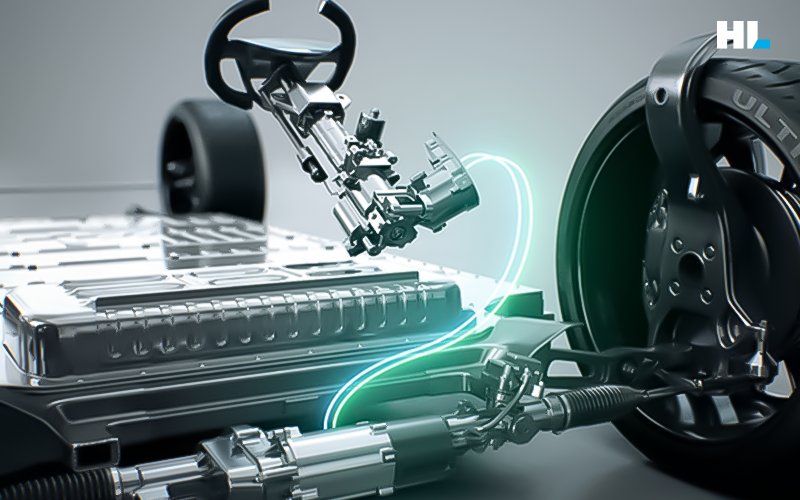
Harrison Bhae: As mechanical linkages are replaced by electrical signals in by-wire systems, system-level safety that preserves functionality even when an individual component fails has become more important than ever.
In the past, the focus was on increasing component reliability and using hardware redundancy to prepare for failures. Today, the key is a sound safety architecture that can respond flexibly to a wide range of fault scenarios. Hardware redundancy and software-based safety must complement each other.
배홍용 : By-Wire로 넘어오면서 기계적 연결 구조가 전기적 신호로 대체되었으니, 일부 부품에 고장이 발생해도 끝까지 기능을 유지하는 ‘시스템 차원’의 안전 설계가 그 무엇보다 중요해졌죠.
과거에는 개별 부품의 신뢰성을 높이고 하드웨어 이중화로 고장에 대비하는 데 집중했다면, 이제는 기본적인 안전 아키텍처를 바탕으로 다양한 고장 상황에 유연하게 대응하는 기술이 핵심이 되었습니다. 이 과정에서 하드웨어 이중화와 소프트웨어 기반 안전 기술은 완벽히 ‘상호 보완적’인 역할을 해야 합니다.
Jongick Won: So rather than choosing between hardware and software because of cost or space constraints, the two must work together like interlocking gears.
원종익 : 원가나 공간 때문에 둘 중 하나를 선택하는 것이 아니라, 두 기술이 톱니바퀴처럼 맞물려야 한다는 말씀이군요.
Harrison Bhae: Exactly. First, we establish robust physical redundancy in the hardware. We then add software that continuously diagnoses system health and detects anomalies early. Fail-operational control uses the available resources to retain control and keep the system safe even after a failure. In an SbW system, for example, software-based fault diagnosis and state estimation complement hardware redundancy, enabling the system to identify anomalies quickly and accurately and maintain steering functionality.
배홍용 : 맞습니다. 하드웨어를 통해 물리적인 기본 이중화를 튼튼하게 확보하고, 그 위에 소프트웨어를 얹어 시스템 상태를 끊임없이 진단해 이상을 조기에 감지하는 거죠. 고장이 발생하더라도 가용한 자원을 영리하게 활용해 안전한 상태로 제어권을 유지하는 ‘고장 허용 제어(Fail-operational)’ 기술이 바로 그 톱니바퀴입니다. SbW를 예로 들면, 하드웨어 이중화 구조에 이러한 소프트웨어 고장 진단 및 상태 추정 기술을 더함으로써, 이상 여부를 빠르고 정확하게 판단해 끝까지 조향 기능을 유지할 수 있게 된 겁니다.
Jongick Won: That means safety is expanding beyond individual components to integrated control of the entire vehicle.
원종익 : 단품의 안전성을 넘어, 차량 전체를 아우르는 통합 제어 관점으로 확장되겠네요.
Harrison Bhae: Precisely. Research now goes beyond fault handling within individual systems to architectures that connect steering, braking, propulsion, ADAS, and other systems to achieve a higher level of safety at the vehicle level.
Real-world development always involves constraints such as cost and system complexity. But one design premise is non-negotiable: safety must be secured. Combining the strengths of hardware and software under that premise to build a highly reliable system will be the true competitive advantage of future by-wire systems.
배홍용 : 정확합니다. 최근에는 개별 시스템의 고장 대응을 넘어 조향, 제동, 구동, ADAS 등 서로 다른 시스템을 엮어 ‘차량 레벨(Vehicle-level)’에서 더 높은 수준의 안전성을 확보하는 아키텍처 연구도 지속적으로 진행 중입니다.
물론 실제 개발 현장에서는 원가나 시스템 복잡도라는 현실적인 제약이 늘 존재하죠. 하지만 제가 결코 타협하지 않는 설계의 대전제는 “안전성 확보는 반드시 충족되어야 하는 기본 원칙”이라는 것입니다. 이 흔들리지 않는 전제 하에 하드웨어와 소프트웨어의 장점을 결합해 신뢰성 높은 시스템을 구현해 내는 것, 그것이 미래 By-Wire 시스템의 진정한 경쟁력이 될 것입니다.
PART 3. The SDV Paradigm Shift: Technology Convergence and New Ways of Working
PART 3. SDV 패러다임 변화 : 기술 융합과 일하는 방식의 혁신
Jongick Won: I strongly agree that hardware and software must work together like interlocking gears. Mechanical, electronics, and software engineers have long collaborated in the automotive industry. As we enter the SDV era, however, it has become more important than ever to maintain expertise in one's own field while understanding and integrating other technologies.
When engineers from different disciplines hold conflicting technical views, what principle matters most in aligning their perspectives?
원종익 : 하드웨어와 소프트웨어가 톱니바퀴처럼 맞물려야 한다는 말씀에 깊이 공감합니다. 사실 자동차 업계에서는 오래전부터 기계, 전자, 소프트웨어 등 다양한 분야의 엔지니어들이 모여 협력해 왔는데요. 최근 SDV 시대로 접어들면서, 각자의 전문성을 유지하면서도 서로 다른 기술을 이해하고 융합하는 역량이 그 어느 때보다 중요해진 것 같습니다.
부사장님께서는 이렇게 다양한 분야의 엔지니어들이 모여 기술적 견해가 상충할 때, 서로의 의견을 조율하는 가장 중요한 원칙이 무엇이라고 보시는지요?
Harrison Bhae: A vehicle is inherently a complex product built through the convergence of many technologies. Different disciplines may have different technical views, but our ultimate goal is the same: to build a high-quality finished product. When resolving disagreements, I emphasize one principle above all: rather than insisting on local objectives, we must find the best solution from the perspective of the entire system.
In the SDV era, we must go beyond optimizing individual systems and deliver new value throughout the vehicle's entire lifecycle. The scope and methods of collaboration must expand accordingly.
배홍용 : 자동차는 본래 다양한 기술이 융합되어 만들어진 복합체입니다. 각 분야의 기술적 견해가 다를 수는 있지만, 우리의 궁극적인 목표는 결국 ‘완성도 높은 제품’을 만드는 것이죠. 제가 이견을 조율할 때 가장 강조하는 원칙은 ‘각자의 부분적인 목표를 고집할 것이 아니라, 전체 시스템 관점에서 최적의 해법을 찾자’는 것입니다.
특히 SDV 시대에는 개별 시스템 단품을 잘 만드는 것을 넘어, 차량 전체의 관점에서 전 생애주기에 걸쳐 새로운 가치를 제공해야 하니 이런 협업의 범위와 방식도 더 확장되어야 하죠.
Jongick Won: So alignment from a total-system perspective is essential. Another challenge researchers face today is balancing speed and safety. We must accelerate development while meeting customers' stringent safety requirements. How must our conventional development methods change to achieve both goals?
원종익 : 전체 시스템 관점에서의 조율이 핵심이군요. 아울러 요즘 저희 연구원들이 마주하는 또 다른 과제가 바로 ‘속도’와 ‘안전’입니다. 고객의 높은 안전성 요구를 충족하면서도 개발 속도까지 빠르게 끌어올려야 하는데요. 이 두 가지 목표를 모두 달성하기 위해, 기존의 개발 방식은 어떻게 변화해야 할까요?
Harrison Bhae: People often treat rapid development and zero-defect safety as a trade-off, but they are not. To achieve both, we must innovate the way we work. Virtual validation, development-process automation, and intelligent engineering tools allow us to identify and address potential issues early in the design process. We should not sacrifice safety and quality for speed. We must raise both through process innovation. That is the convergence capability we need most today.
배홍용 : 흔히들 빠른 개발 속도와 무결점의 안전성을 선택의 문제나 타협의 대상으로 보곤 하는데, 절대 그렇지 않습니다. 두 마리 토끼를 다 잡으려면 우리가 ‘일하는 방식’ 자체를 영리하게 혁신해야 해요. 예를 들어 가상 검증(Virtual Validation)이나 개발 공정의 자동화, 지능화를 적극적으로 도입하면 초기 설계 단계부터 발생 가능한 문제들을 신속하게 검토하고 개선할 수 있죠. 속도를 높이기 위해 안전성과 품질을 양보하는 것이 아니라, 개발 방식의 혁신을 통해 두 가지 목표를 동시에 끌어올리는 것. 그것이 지금 우리에게 가장 필요한 융합 역량입니다.
PART 4. Advice from a Senior Engineer and a Question for the Next Generation
PART 4. 선배 엔지니어의 당부, 그리고 후배들에게 던지는 질문
Jongick Won: Your point about innovating how we work is thought-provoking. Thank you for giving us clear guideposts for the difficult questions we face every day.
As we close, what advice would you like to offer the junior engineers following in your footsteps? And what question would you like to leave with us as a senior engineer?
원종익: '방식의 혁신'이라는 말씀이 묵직한 자극이 됩니다. 긴 시간, 현업에서 매일 부딪히는 치열한 고민들에 명쾌한 이정표를 세워 주셔서 정말 감사합니다.
대담을 마무리하며, 부사장님의 앞선 걸음을 뒤따르는 저희 주니어들에게 남기고 싶으신 당부, 그리고 선배로서 저희에게 던지고 싶으셨던 질문이 있다면 이 자리를 빌려 편하게 한 말씀 부탁드립니다!
Harrison Bhae: What I want to emphasize most to junior engineers is the importance of continuous learning and a willingness to take on challenges. Automotive technology has evolved from mechanical systems to electronic control, software, and now AI, and it will continue to change faster than we can imagine.
Yet no matter how quickly technology changes, the fundamental principles of engineering remain the same. Understand the root of the problem, take responsibility for your technical judgment, and persist until you find a solution. Do not try to do everything alone; collaborate openly with colleagues across disciplines. I hope you grow into engineers who define problems and find answers for yourselves, rather than merely applying existing technologies.
배홍용: 제가 후배 엔지니어들에게 가장 강조하고 싶은 건 ‘끊임없이 배우고 도전하는 자세’입니다. 기계 중심에서 전자 제어와 소프트웨어, 그리고 이제는 AI까지... 자동차 기술은 앞으로 우리의 상상보다 훨씬 더 빠르게 변할 겁니다.
하지만 기술 트렌드가 아무리 급변해도 엔지니어가 지켜야 할 기본적인 원칙은 결코 변하지 않아요. 문제의 본질을 깊이 이해하고, 자신의 기술적 판단에 책임을 지며, 끝까지 해결책을 찾아내는 끈기를 잃지 않았으면 합니다. 혼자서 다 하려 하지 말고 다양한 분야의 동료들과 열린 마음으로 협력하면서요. 주어진 기술을 그저 따라 쓰는 사람이 아니라, 스스로 문제를 정의하고 해답을 찾아가는 엔지니어로 성장하길 진심으로 응원합니다.
Harrison Bhae: Finally, I would like to ask our younger colleagues in their 20s and 30s, including you, a question.
배홍용: 마지막으로 원 연구원을 비롯한 우리 2030 후배들에게 저도 질문을 하나 던지고 싶네요.
"What kind of engineer do you want to be 10 or 20 years from now? What new value do you want your engineering to create?"
"여러분은 앞으로 10년 후, 혹은 20년 후 어떤 엔지니어가 되고 싶습니까? 스스로 어떤 새로운 가치를 만들어 내는 엔지니어링을 하고 싶습니까?"
The demanding tasks and results immediately in front of us matter. But if you hold a meaningful goal of your own in response to this question and continue to challenge yourself, you will eventually develop distinctive expertise and achieve meaningful results.
One hint that may help you find your answer is to take a close look at the philosophy embedded in HPDS (HL Product Development System, HL Mando's standard development process), our company's unique development framework (laughs).
당장 눈앞의 고단한 업무와 성과도 중요하지만, 이 질문에 대한 본인만의 묵직한 목표를 품고 끊임없이 도전한다면 훗날 여러분만의 독보적인 전문성과 의미 있는 성과를 만들어 갈 수 있을 겁니다.
아, 이 답을 찾는 데 도움이 될 만한 힌트를 하나 드리자면... 우리 회사의 고유한 개발 체계인 HPDS(HL Product Development System, HL만도의 개발 표준 프로세스)에 담긴 철학을 한번 찬찬히 들여다보라고 권하고 싶네요(웃음).


