
[Expert Column] Moving Intelligence: The Next Humanoid Race After AI Gets a Body
[Editor’s Note]
본 아티클은 오토모티브 일렉트로닉스(AEM) 한상민 편집장의 전문가 칼럼입니다. AI 지능(Software)이 실제 산업 현장의 노동력(Physical AI)으로 자리 잡기 위해 넘어야 할 하드웨어 메커니즘과 시스템 엔지니어링의 본질을 깊이 있게 짚어봅니다.
글 / 한상민 Sang Min Han 편집장, AEM han@autoelectronics.co.kr
[Editor’s Note] This article is an expert column by Sang Min Han, Editor-in-Chief of Automotive Electronics (AEM). It deeply explores the essence of hardware mechanisms and system engineering that AI intelligence (Software) must overcome to establish itself as a practical workforce (Physical AI) in actual industrial fields.
Written by Sang Min Han, Editor-in-Chief, AEM han@autoelectronics.co.kr
[내용 미리보기]
- 👉 1막. 뇌가 손을 만나다
- 👉 2막. 기대와 실행 사이의 간격
- 👉 3막. 다섯 개의 층, 그리고 판단이 힘을 얻는 곳
- 👉 4막. 왜 다시 자동차인가
- 👉 5막. 신뢰는 계약 뒤에 오지 않는다
- 👉 6막. 박수받지 않는 동작에 대해
[Preview]
- 👉 Act 1. The Brain Meets the Hand
- 👉 Act 2. The Gap Between Expectation and Execution
- 👉 Act 3. Five Layers, and Where Judgment Gains Power
- 👉 Act 4. Why the Automotive Industry Again?
- 👉 Act 5. Trust Does Not Follow a Contract
- 👉 Act 6. On Movements That Receive No Applause
공중제비를 도는 로봇, 음악에 맞춰 춤을 추는 로봇, 심지어 격투기를 하는 로봇. 이런 영상은 수천만 번 재생됐습니다. 사람들은 로봇이 넘어지지 않는지 지켜보다가 동작이 끝나는 순간 박수를 보냅니다. 이 완성된 동작은 그 자체로 기술의 진보를 증명하는 것처럼 보였습니다. 그런데 공장은 박수를 치지 않습니다. 공장이 묻는 것은 그런 동작을 오늘 한 번 해낼 수 있느냐가 아닙니다. 내일도, 모레도, 한 달 뒤에도 부품의 위치와 온도가 조금씩 달라진 상황에서 같은 힘과 같은 속도로 반복할 수 있느냐입니다. 화려한 한 번의 동작은 데모가 되지만, 아무도 눈여겨보지 않는 동작을 수천 번 반복하는 능력만이 비로소 ‘산업’이 될 수 있습니다.
A robot doing a backflip, a robot dancing to music, and even a robot doing martial arts. These videos have been played tens of millions of times. People watch to see if the robot falls and applaud the moment the movement ends. This completed motion itself seemed to prove the advancement of technology. However, factories do not applaud. What factories ask is not whether such a movement can be done once today. The question is whether it can repeat the motion with the same force and speed tomorrow, the day after, and a month later, even when the positions and temperatures of parts vary slightly. A single flashy movement can serve as a demo, but only the ability to repeat an unnoticed movement thousands of times can truly become an "industry".

영화 《모던 타임즈》(Modern Times, 1936)의 한 장면은 자동화를 이야기할 때마다 소환됩니다. 컨베이어벨트 앞에서 나사를 조이던 채플린, 그리고 끝내 톱니바퀴 사이로 빨려 들어가던 몸짓은 이후로도 숱한 다큐멘터리, 강연, 만평에서 반복되어 왔습니다. 사람들은 그 장면에서 인간이 기계의 속도에 종속된 시대를 읽었습니다.
A scene from the movie Modern Times (1936) is often brought up whenever automation is discussed.. Chaplin tightening screws in front of a conveyor belt, and his body eventually being sucked into the gears, has since been repeated in countless documentaries, lectures, and cartoons. People read in that scene an era where humans were subordinated to the speed of machines.
그런데, 휴머노이드의 시대에는 이 장면을 반대로 봐야 합니다.
However, in the age of humanoids, this scene must be viewed in reverse.
《모던 타임즈》의 반전
*과거 : 기계의 속도와 단순 반복을 견뎌야 했던 ‘인간’
*현재 : 인간의 8시간 반복과 미세한 힘 조절을 구현해야 하는 ‘기계’
The Twist of Modern Times
*Past: "Humans" who had to endure the speed and simple repetition of machines.
*Present: "Machines" that must embody the 8-hour repetition and fine force control of humans.
반복을 견뎌야 했던 것은 인간이었습니다. 이제 그 자리에 기계가 서려 합니다. 계단을 오르고, 상자를 옮기고, 공구를 쥐고, 작업대 앞에서 사람과 같은 일을 수행하려 합니다. 그리고 인간에게는 너무 당연했던 8시간의 반복과 순간적인 힘 조절, 미세한 환경 변화에 대한 적응력이 로봇에게는 가장 넘기 어려운 벽입니다.
It was humans who had to endure repetition. Now, machines are about to stand in that place. They are trying to climb stairs, move boxes, grip tools, and perform human-like tasks at workbenches. And the 8 hours of repetition, instantaneous force control, and adaptability to subtle environmental changes—which were so natural to humans—are the most difficult barriers for robots to overcome.
AI가 몸을 얻기 시작했습니다. 그리고 그 몸을 산업으로 만드는 일이 이제 겨우 시작됐습니다.
AI has begun to acquire a body. And turning that body into an industry has only just begun.
1막. 뇌가 손을 만나다
Act 1. The Brain Meets the Hand
과거의 산업용 로봇은 정해진 좌표와 순서를 그대로 반복하도록 설계됐습니다. 정해진 위치와 조건에서 벗어나면 공정은 쉽게 멈췄고, 변화에 대응하려면 다시 프로그래밍을 해야 했습니다.
Industrial robots of the past were designed to exactly repeat predetermined coordinates and sequences. The process easily stopped if they deviated from set positions and conditions, and adapting to changes required reprogramming.
하지만 지금의 로봇은 다릅니다. 카메라와 센서로 주변을 읽고, 사람의 말을 이해하며, 처음 보는 물체 앞에서도 스스로 해결 방법을 찾으려 합니다.
However, today's robots are different. They read their surroundings with cameras and sensors, understand human speech, and try to find solutions on their own even when faced with unseen objects.
서로 다른 기술의 발전이 비슷한 시기에 맞물렸습니다. 시각과 언어, 행동을 함께 학습하는 로봇 파운데이션 모델이 등장했습니다. 위험한 시행착오는 시뮬레이션과 디지털 트윈 환경에서 먼저 검증되고, 현실에서 얻은 움직임은 다시 학습 데이터로 피드백됩니다. 사람의 동작을 따라 하던 로봇이 이제는 실패의 과정과 결과까지 함께 배웁니다. 클라우드 의존을 줄이고 로봇 안에서 즉시 판단할 수 있게 하는 엣지 컴퓨팅(Edge Computing)과 손끝의 압력 및 미끄러짐을 감지하는 촉각 센서까지 갖춰지면서, 로봇은 ‘프로그램된 기계’에서 ‘스스로 배우는 물리 시스템’으로 발전하고 있습니다.
The advancement of different technologies converged around the same time. Robot foundation models that co-learn vision, language, and action have emerged. Dangerous trial-and-errors are first verified in simulation and digital twin environments, and movements acquired in reality are fed back as training data. Robots that used to mimic human motions now learn the processes and results of failure as well. Equipped with Edge Computing that reduces cloud dependency and enables immediate judgment within the robot, along with tactile sensors that detect fingertip pressure and slippage, robots are evolving from "programmed machines" to "self-learning physical systems".
하지만 이러한 흐름을 지켜보다 보면 놓치기 쉬운 전제가 하나 있습니다. 몸을 얻는 일과 그 몸이 공장의 실질적인 노동력이 되는 일 사이에는 아직 커다란 격차가 존재한다는 사실입니다.
However, when observing this trend, there is one premise that is easy to miss. It is the fact that a massive gap still exists between acquiring a body and that body becoming a practical workforce in a factory.
2막. 기대와 실행 사이의 간격
Act 2. The Gap Between Expectation and Execution
세계경제포럼(WEF)과 보스턴컨설팅그룹(BCG)이 발간한 보고서에 따르면, 2023년 기준 전 세계에서 가동 중인 산업용 로봇은 이미 400만 대를 넘어섰습니다. 로봇 자체는 새로운 산업이 아닙니다. 하지만, AI를 지닌 로봇, 특히 휴머노이드는 차원이 다릅니다.
According to a report published by the World Economic Forum (WEF) and Boston Consulting Group (BCG), the number of industrial robots in operation worldwide had already exceeded 4 million as of 2023. The robot itself is not a new industry. However, robots with AI, especially humanoids, are on an entirely different level.
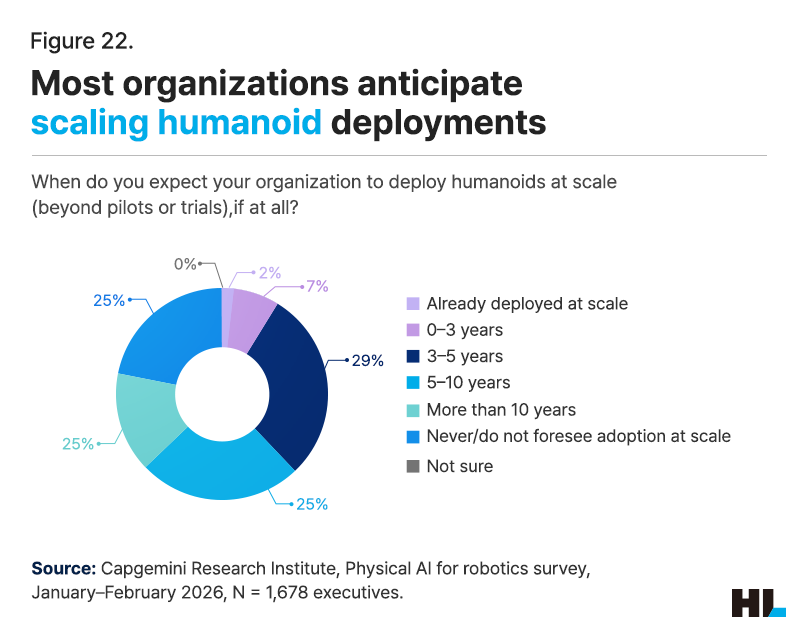
캡제미니 리서치 인스티튜트(Capgemini Research Institute)가 16개국 1,678명의 경영진을 조사한 결과, 67%는 휴머노이드가 궁극적으로 자신의 산업을 바꿀 것이라고 답했습니다. 그러나 조직 차원의 대규모 도입까지 예상한 시간은 평균 7년이었습니다. 3년에서 5년 안에 범용 노동력으로 쓸 수 있으리라 답한 비율은 30%에 그쳤습니다.
When the Capgemini Research Institute surveyed 1,678 executives across 16 countries, 67% responded that humanoids would ultimately transform their industries. However, the average estimated time for large-scale organizational deployment was 7 years. Only 30% replied that they could be used as a general-purpose workforce within 3 to 5 years.
| 조사 항목 | 응답 수치 | 현장의 시사점 |
| 휴머노이드의 산업 변혁 가능성 동의 | 67% | 기술적 잠재력 및 미래 가치 인정 |
| 대규모 도입 예상 시점 | 평균 7년 후 | 상용화 및 현장 배치까지 시차 존재 |
| 3~5년 내 범용 노동력 활용 가능 예상 | 30% | 조기 상용화에 대해서는 보수적 시각 |
| 도입 장애 : 기술적 미성숙 (성능/신뢰성) |
72% | 반복 가동 시의 오차 및 내구성 미달 |
| 도입 장애 : 높은 초기 비용 | 63% | 기존 자동화 설비 대비 ROI 검증 필요 |
| 안전성 신뢰도 (사람 곁에서의 작동) |
42% | 협업 환경에서의 안전성 검증 과제 |
| Survey Item | Response Rate | On-site Implications |
| Agreement on humanoids' potential for industrial transformation | 67% | Recognition of technological potential and future value |
| Expected time for large-scale deployment | Average of 7 years later | Existence of a time lag before commercialization and field deployment |
| Expectation of utilization as a general-purpose workforce within 3-5 years | 30% | Conservative view on early commercialization |
| Deployment obstacle: Technological immaturity (Performance/Reliability) | 72% | Margin of error and lack of durability during repetitive operations |
| Deployment obstacle: High initial costs | 63% | Need for ROI verification compared to existing automation equipment |
| Reliability of safety (Operation alongside humans) | 42% | Safety verification challenges in a collaborative environment |
이러한 시차를 만드는 것은 단순한 기대의 부족이 아닙니다. 지능을 뒷받침할 로봇의 ‘몸’과 ‘현장 환경’이 아직 따라가지 못한 현실 때문입니다.
What creates this time gap is not a simple lack of expectation. It is due to the reality that the robot's "body" and the "field environment" to support the intelligence have not yet caught up.
지능은 이미 휴머노이드 경쟁의 전면으로 들어왔습니다. 그러나 산업화를 가로막는 진짜 관문은 지능이라기보다 몸과 현장 쪽에 더 촘촘히 쌓여 있습니다. 손은 물체를 쥐고 균형을 잡아야 하고, 접촉하는 순간에는 힘을 즉시 조절해야 하며, 동작을 반복할수록 오차는 조금씩 벌어질 수 있습니다. 발열과 배터리는 하루 8시간의 가동을 버텨야 하고, 반복된 충격은 부품의 수명을 갉아먹습니다. 통신 및 전자파 간섭 속에서도 안전을 지켜야 하고, 부품마다 발생하는 편차와 고장 시 유지보수까지 감당해야 합니다. 그 과제의 목록은 결코 짧지 않습니다.
Intelligence has already entered the forefront of the humanoid race. However, the true gateways blocking industrialization are piled up more densely on the physical body and field side rather than on intelligence. Hands must grip objects and balance, force must be adjusted immediately at the moment of contact, and margins of error can gradually widen as motions are repeated. Heat generation and batteries must withstand 8 hours of daily operation, and repeated impacts erode the lifespan of components. Safety must be maintained even amidst communication and electromagnetic interference, and deviations in each part alongside maintenance during breakdowns must also be managed. The list of these tasks is by no means short.
항목들을 하나하나 떼어 놓고 보면 사소해 보일 수 있습니다. 하지만 로봇이 하루 8시간, 수천 번의 동작을 반복해야 한다면 이야기는 달라집니다. 실험실에서 한 번 성공한 동작과 현장에서 매일 재현되는 동작 사이에는 휴머노이드 산업이 아직 메우지 못한 간격이 존재합니다.
When looking at the items one by one, they may seem trivial. But if a robot has to repeat thousands of motions for 8 hours a day, the story changes. Between a movement that succeeds once in a lab and a movement reproduced every day in the field, there lies a gap that the humanoid industry has not yet bridged.
3막. 다섯 개의 층, 그리고 판단이 힘을 얻는 곳
Act 3. Five Layers, and Where Judgment Gains Power
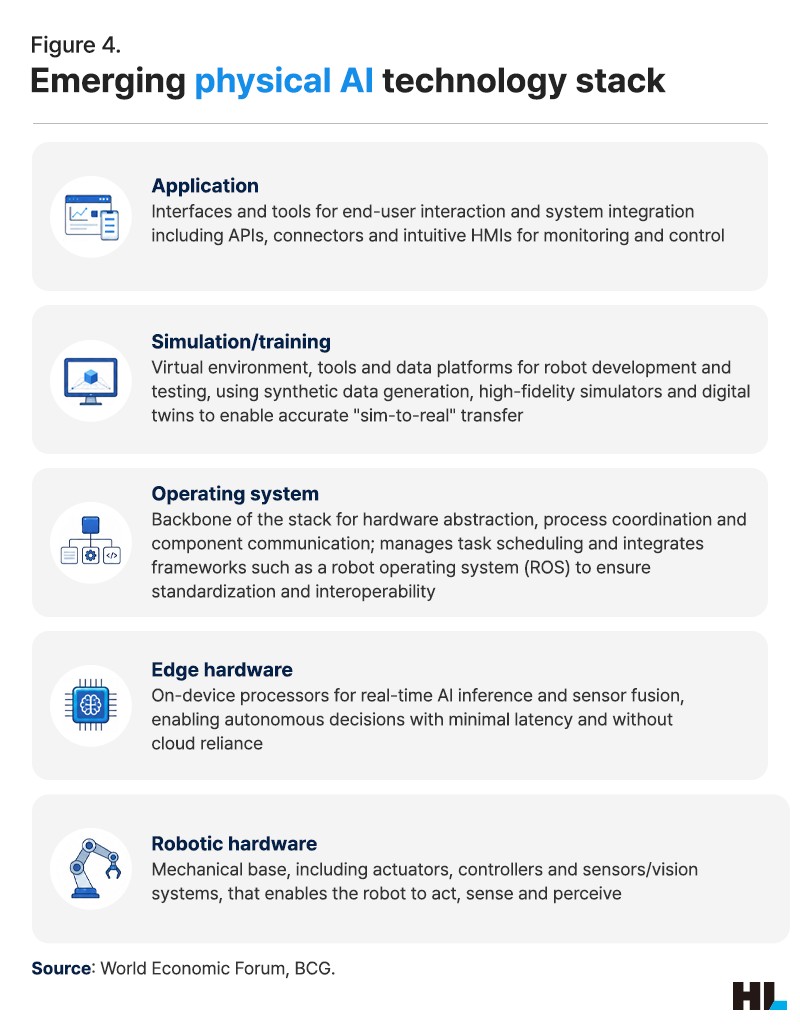
이 문제를 좀 더 또렷하게 보려면, 피지컬 AI(Physical AI)를 하나의 덩어리가 아니라 여러 개의 계층(Layer)으로 나눠 볼 필요가 있습니다. 세계경제포럼과 보스턴컨설팅그룹은 이 구조를 다섯 개의 층으로 정리했습니다.
To see this problem more clearly, it is necessary to divide Physical AI into multiple layers rather than viewing it as a single mass. The World Economic Forum and Boston Consulting Group structured this into five layers.
[Physical AI의 5개 계층 구조]
1. 응용 계층 (Application Layer) : 사용자와 현장을 연결
2. 시뮬레이션 계층 (Simulation Layer) : 가상 환경에서 사전 훈련
3. 운영체제 계층 (OS Layer) : 작업을 나누고 조율
4. 엣지 하드웨어 계층 (Edge HW Layer) : 실시간 판단 수행
5. 로봇 하드웨어 계층 (Robot HW Layer) : 실제로 힘을 만들고 전달 (모터/감속기/컨트롤러)
[5-Layer Structure of Physical AI]
1. Application Layer: Connects users and the field.
2. Simulation Layer: Pre-training in a virtual environment.
3. OS Layer: Divides and coordinates tasks.
4. Edge HW Layer: Executes real-time judgments.
5. Robot HW Layer: Actually creates and transmits force (Motors/Reducers/Controllers).
출처 : World Economic Forum & Boson Consulting Group
여기서 한 가지 중요한 의문이 생깁니다. 상위 계층에서 내려온 판단이 실제 움직임으로 구현되기 위해 마지막으로 통과해야 하는 곳은 어디일까요?
Here, an important question arises. Where is the final gateway that judgments passed down from the upper layers must go through to be realized as actual movements?
AI와 운영체제는 무엇을 할지 결정하지만, 실제 물리 세계와 부딪히는 것은 가장 아래에 있는 로봇의 몸입니다. 힘을 만드는 모터, 그 힘을 관절에 맞게 바꾸는 감속기, 열과 전자파 속에서도 전력과 움직임을 제어하는 컨트롤러가 유기적으로 작동해야 상위 계층의 판단이 비로소 실제 움직임으로 바뀝니다. 이 계층에 이르러서야 지능은 비로소 현실의 속도와 힘을 얻습니다.
AI and the operating system decide what to do, but it is the robot's physical body at the very bottom that collides with the actual physical world. Only when the motors that create force, the reducers that convert that force to suit the joints, and the controllers that manage power and movement despite heat and electromagnetic waves work organically can the upper layers' judgments finally turn into actual movements. It is only upon reaching this layer that intelligence finally acquires the speed and power of reality.
그 원리는 인간의 몸에도 이미 새겨져 있습니다. 뜨거운 것에 손이 닿으면 통증을 의식하기도 전에 손이 먼저 떨어집니다. 대뇌의 판단을 기다리지 않고 척수의 반사 회로가 먼저 반응하기 때문입니다. 추론과 상위 조율은 높은 층이 맡지만, 접촉의 순간에 필요한 정밀한 반응은 몸과 가장 가까운 곳에서 즉시 일어나야 합니다.
That principle is already engraved in the human body as well. When a hand touches something hot, it pulls away before one even becomes conscious of the pain. This is because the spinal reflex circuit reacts first without waiting for the cerebrum's judgment. Inference and higher-level coordination are handled by the upper layers, but the precise reactions required at the moment of contact must occur immediately at the point closest to the body.
로봇에도 이와 같은 역할 분담이 필요합니다. 판단이 아무리 정교해도 접촉의 순간마다 상위 시스템이나 클라우드의 결정을 기다려야 한다면 반응은 늦을 수밖에 없습니다.
Robots also need this kind of role division. No matter how sophisticated the judgment is, if they must wait for decisions from upper systems or the cloud at every moment of contact, the response is bound to be delayed.
4막. 왜 다시 자동차인가
Act 4. Why the Automotive Industry Again?
로보틱스 분야에서 자동차 산업이 다시 주목받는 이유는 단순히 모터와 센서를 오래 다뤄왔기 때문이 아닙니다. 자동차 산업은 전자 명령을 실제 제동과 조향, 토크로 바꾸는 메커니즘을 오랫동안 다뤄왔습니다. 진동과 충격, 고온과 전자파 속에서도 성능을 지켜냈고, 부품의 편차와 마모 속에서도 균일한 품질을 유지해 왔습니다. 무엇보다 고장이 났을 때 시스템을 안전한 상태로 복귀시키고, 원인을 끝까지 추적해온 노하우를 갖고 있습니다. 수백만 대를 대량 생산하면서도 매번 동일한 성능을 보장해온 산업은 흔치 않습니다. 자동차 산업이 로봇 생태계에 건넬 수 있는 것은 단순한 부품 목록이 아니라, 바로 이 ‘시스템 엔지니어링의 경험’ 그 자체입니다.
The reason the automotive industry is once again drawing attention in the robotics field is not simply because it has dealt with motors and sensors for a long time. The automotive industry has long managed the mechanisms that convert electronic commands into actual braking, steering, and torque. It has maintained performance amid vibration, shock, high temperatures, and electromagnetic waves, and kept uniform quality despite parts variation and wear. Above all, it possesses the know-how to return systems to a safe state when breakdowns occur and to track the causes to the end. There are not many industries that have guaranteed consistent performance every time while mass-producing millions of units. What the automotive industry can offer the robotics ecosystem is not a mere catalog of parts, but this "experience of system engineering" itself.
자율주행이 자동차와 도로를 중심으로 생태계를 형성했다면, 로보틱스는 제품과 산업의 경계가 훨씬 흐릿합니다. 완성차와 부품사뿐만 아니라 AI 파운데이션 모델 기업, 반도체 회사, 기존 산업용 로봇 기업, 물류 플랫폼, 가전 기업, 그리고 중국의 방대한 부품 공급망까지 서로 다른 출발선에서 같은 시장으로 진입하고 있습니다. 경쟁자 숫자보다 더 중요한 것은, 서로 다른 사업 방식을 가진 기업들이 휴머노이드 주도권을 동시에 노리고 있다는 점입니다.
If autonomous driving formed an ecosystem centered around cars and roads, robotics has much blurrier boundaries between products and industries. Not only automakers and parts suppliers, but also AI foundation model companies, semiconductor companies, traditional industrial robot firms, logistics platforms, home appliance makers, and China's vast parts supply chain are all entering the same market from different starting lines. What is more important than the number of competitors is that companies with different business approaches are simultaneously aiming for humanoid leadership.
이 넓어진 경쟁 구도 안에서 기업들의 조건도 저마다 다릅니다. 누군가는 완성차와 부품사, 로봇 플랫폼을 이미 수직계열화로 엮어 놓았고, 누군가는 그 구조 밖에서 여러 고객 및 시장을 통해 스스로 가치를 증명해야 합니다. CES 2026에서 현대자동차그룹은 보스턴다이내믹스의 로봇 플랫폼, 현대모비스의 액추에이터, 현대차·기아의 대량생산 역량과 글로벌 공장을 하나의 사슬로 연결하는 구조를 제시했습니다. 현대차그룹은 2028년 미국 조지아 메타플랜트에서 부품 시퀀싱 작업을 시작으로 아틀라스를 단계적으로 배치하고, 2030년에는 부품 조립으로 적용 범위를 확대할 계획이라고 밝혔습니다. 완성차의 생산 경험과 그룹 공장은 로봇의 검증 및 양산 기반이 됩니다.
Within this broadened competitive landscape, the conditions of companies also vary. Some have already vertically integrated automakers, parts suppliers, and robot platforms, while others outside that structure must prove their own value through various customers and markets. At CES 2026, Hyundai Motor Group presented a structure linking Boston Dynamics' robot platform, Hyundai Mobis' actuators, and Hyundai and Kia's mass production capabilities and global factories into a single chain. Hyundai Motor Group announced plans to phase in the Atlas robot, starting with parts sequencing operations at the Georgia Metaplant in the US in 2028, and expanding its application scope to parts assembly by 2030. The automaker's production experience and group factories serve as a foundation for robot verification and mass production.
여기서 공장은 단순한 수요처가 아닙니다. 휴머노이드의 작업성을 검증하는 시험장이자, 실패를 데이터로 바꾸는 현장이며, 대외 시장이 무르익기 전에 내부 수요로 양산 기반을 선제 확보하는 자리입니다.
Here, a factory is not just a source of demand. It is a testing ground for verifying the workability of humanoids, a site that converts failures into data, and a place to preemptively secure a mass production base through internal demand before external markets mature.
이러한 수직통합 구조를 모든 기업이 가질 수 있는 것은 아닙니다. 하지만 내부 수요에 의존하지 않는 독립 부품기업에는 또 다른 가능성이 열려 있습니다. 이미 글로벌 기업 로봇에 액추에이터를 공급해온 HL만도의 경험은 캡티브 시장 밖의 실제 플랫폼에서 기술력을 검증받은 대표적인 경로를 보여줍니다.
Not every company can possess such a vertically integrated structure. However, another possibility remains open for independent parts companies that do not rely on internal demand. The experience of HL Mando, which has already supplied actuators for global companies' robots, shows a representative path of proving technological prowess on actual platforms outside captive markets.
독립 부품기업의 다음 과제는 단일 로봇 플랫폼에 머물지 않고, 다양한 산업 현장을 가로지르며 서로 다른 움직임의 요구조건을 하나의 공통 기준으로 통합해내는 일입니다. 이미 완성된 기술을 납품하는 관계를 넘어, 아직 정답이 없는 움직임의 표준을 함께 정의하는 파트너십으로 나아가는 것입니다. 그리고 이를 위해서는 기술의 범용성뿐만 아니라 고객과 실패의 데이터까지 투명하게 공유할 수 있는 깊은 신뢰가 전제되어야 합니다.
The next task for independent parts companies is not to remain tied to a single robot platform, but to cross various industrial fields and integrate the different movement requirements into a single common standard. It goes beyond the relationship of merely supplying perfected technologies to advancing into a partnership that jointly defines the yet-unanswered standards of movement. And for this to happen, not only the universality of the technology but also a deep trust that allows transparent sharing of customer and failure data must be a prerequisite.
5막. 신뢰는 계약 뒤에 오지 않는다
Act 5. Trust Does Not Follow a Contract
함께 문제를 발견하고, 그 원인을 데이터로 남기며, 다음 설계에 즉시 반영할 수 있다는 확신. 로봇산업에서 신뢰는 계약 뒤에 따라오는 결과가 아니라, 공동개발을 시작하기 위한 필수 전제조건입니다. 이 시장에서 부품기업은 로봇 제조사와 초기 설계 단계부터 한 몸처럼 움직여야 합니다. 정해지지 않은 사양을 함께 정의하고, 다양한 형태의 로봇 플랫폼에 가변적으로 대응할 수 있어야 합니다.
The confidence that partners can discover problems together, record the causes as data, and immediately reflect them in the next design. In the robot industry, trust is not a result that follows a contract, but an essential prerequisite to begin joint development. In this market, parts companies must move as one body with robot manufacturers from the early design stages. They must define undetermined specifications together and be able to respond variably to diverse forms of robot platforms.
로봇산업에서 설계를 수주하는 일은 단순히 카탈로그에 있는 부품을 고르는 것으로 끝나지 않습니다.
Winning a design contract in the robotics industry does not end with simply picking parts from a catalog.
- 약속한 토크가 시간이 지나도 변함없이 재현되는가?
IS the promised torque consistently reproduced over time? - 열과 충격 속에서도 성능이 흔들리지 않는가?
Does the performance remain unwavering even amid heat and shock? - 문제가 발생했을 때 그 원인을 함께 규명할 수 있는가?
Can the cause be jointly investigated when a problem occurs? - 고객의 빠른 설계 변경 속도를 함께 맞춰갈 수 있는가?
Can they keep pace with the customer's rapid speed of design changes?
이 질문들에 명확히 답하지 못하면 단발성 납품은 가능할지 몰라도 다음 설계에는 참여할 수 없습니다. 20세기 자동차 산업이 컨베이어 벨트 위에서 생산성을 겨뤘다면, 21세기 로봇산업의 경쟁은 개발 과정에서 발견한 실패 데이터를 얼마나 빠르게 차세대 설계로 피드백하느냐에서 갈릴 것입니다.
If these questions cannot be answered clearly, a one-off delivery might be possible, but participation in the next design will not be. If the 20th-century automotive industry competed on productivity over conveyor belts, the 21st-century robotics industry competition will be decided by how quickly failure data discovered during development is fed back into next-generation designs.
그리고 이 반복 가능한 움직임을 완성하는 핵심 하드웨어 3요소가 바로 모터, 감속기, 컨트롤러입니다.
And the three core hardware elements that complete these repeatable movements are motors, reducers, and controllers.
- 모터(Motor) : 좁은 관절 공간 내부에서 강력한 힘을 만들어내야 하지만, 출력이 높아질수록 발생하는 발열 문제와 양산 한계를 극복해야 합니다.
Motor: Must generate strong force within narrow joint spaces, but must overcome heat generation issues and mass production limits that arise as output increases. - 감속기(Reducer) : 모터의 회전력을 관절에 맞는 토크와 속도로 변환하지만, 초정밀도 유지, 충격 내구성, 부품 자체의 기술 자립이라는 숙제를 안고 있습니다.
Reducer (Gearbox): Converts the motor's rotational force into torque and speed suitable for the joints, but faces challenges such as maintaining ultra-precision, shock durability, and technological independence of the parts themselves. - 컨트롤러(Controller) : 전력과 움직임을 매 순간 제어하지만, 전력 밀도를 높일수록 발생하는 전자파 간섭(EMI)과 기능안전(Functional Safety)의 위험을 통제해야 합니다.
Controller: Controls power and movement at every moment, but must manage the risks of electromagnetic interference (EMI) and functional safety that occur as power density increases.
성능을 끌어올릴 때마다 새로운 기술적 위험이 동반되며, 휴머노이드의 산업화는 바로 이 위험 요소들을 하나씩 제어해 나가는 과정에서 비로소 완성됩니다.
Every time performance is elevated, new technical risks accompany it, and the industrialization of humanoids is only completed through the process of systematically controlling these risk factors one by one.
6막. 박수받지 않는 동작에 대해
Act 6. On Movements That Receive No Applause
《모던 타임즈》의 컨베이어벨트는 인간에게 기계의 리듬을 요구했습니다. 90년이 지난 지금, 공장은 반대로 로봇에게 인간의 리듬을 요구하기 시작했습니다. 단단한 물체와 깨지기 쉬운 물체를 구분하고, 예상치 못한 접촉 앞에서 힘을 늦추며, 같은 동작을 수천 번 정확히 되풀이하라는 요구입니다.
The conveyor belt in Modern Times demanded the rhythm of machines from humans. Ninety years later, factories are conversely starting to demand the rhythm of humans from robots. It is the demand to distinguish between solid and fragile objects, to loosen their grip when faced with unexpected contact, and to accurately repeat the same movement thousands of times.
이를 가능하게 하는 것은 단순한 AI 모델 하나가 아닙니다. 모터가 힘을 만들고, 감속기가 그 힘을 정확히 전달하며, 컨트롤러가 매 순간 움직임을 제어해야만 합니다. 이 움직임은 현장에서의 시행착오와 수정, 그리고 고객사와 공급사가 데이터를 투명하게 나누는 과정을 거쳐서야 비로소 산업의 신뢰를 얻게 됩니다.
What makes this possible is not a single AI model. Motors must create force, reducers must transmit that force precisely, and controllers must govern movement at every moment. These movements will only earn the industry's trust after undergoing trial and error and modifications in the field, as well as the process of clients and suppliers sharing data transparently.
단 한 번의 공중제비는 사람들을 놀라게 하고 박수를 끌어냅니다. 하지만 로봇산업의 진짜 미래를 만드는 것은 아무도 박수치지 않는 수천 번째의 정밀한 반복 동작입니다. AI가 몸을 얻은 지금, 지능은 더 이상 가상의 생각이 아니라 ‘현장에서 검증된 반복 가능한 움직임’으로 증명되어야 합니다.
A single backflip surprises people and draws applause. But what truly creates the future of the robot industry is the thousandth precise, repetitive movement that nobody applauds. Now that AI has gained a body, intelligence must no longer be proven as an imaginary thought, but as "repeatable movements verified in the field".
🔗 [HL 로봇 인사이트 심층 연재]
🔗 [HL Robot Insights In-Depth Series]
HL만도 Robot Actuator 개발팀 연구원들이 직접 전하는 로봇 3대 핵심 하드웨어의 기술 칼럼도 만나보세요.
Read the technical columns on the three core robotic hardware pieces delivered directly by researchers from the HL Mando Robot Actuator Development Team.
- 박종훈 책임연구원 [로보틱스 인사이트] ① 모터 편
[로보틱스 인사이트] 휴머노이드의 근육, 고출력 밀도 액추에이터 기술의 진화와 과제 : ① 모터
Author’s Note 안녕하세요, HL만도 Robot Actuator 개발팀 박종훈 책임연구원입니다. 전 세계가 모빌리티의 전동화와 자율주행 기술을 고도화하는 사이, 또 하나의 거대한 격전지가 우리 앞에 모습을
www.hlworld.com
- 유동준 책임연구원 [로보틱스 인사이트] ② 감속기 편
[로보틱스 인사이트] 휴머노이드 관절, 고출력 밀도 액추에이터 기술의 진화와 과제 : ②감속기
Author’s Note안녕하세요, HL만도 Robot Actuator 개발팀 유동준 책임연구원입니다. 지난 1편에서는 휴머노이드 로봇의 강력한 근육이자 심장 역할을 하는 고출력 밀도 모터 설계 기술을 살펴보았습니
www.hlworld.com
- 배상원 책임연구원 [로보틱스 인사이트] ③ 컨트롤러 편
[로보틱스 인사이트] 휴머노이드 관절, 고출력 밀도 액추에이터 기술의 진화와 과제 : ③ 컨트롤
Author’s Note안녕하세요, HL만도 Robot Actuator 개발팀 배상원 책임연구원입니다. 앞선 시리즈를 통해 휴머노이드 로봇이 힘을 내는 근육인 ‘모터’와 그 힘을 정교하게 조율하는 ‘감속기’를 살
www.hlworld.com
※ 본 글은 외부 필진의 기고문으로 HL그룹의 공식 입장과 무관합니다.
※ This article is a contribution from an external writer and does not necessarily reflect the official position of HL Group.


